Showing posts with label listening. Show all posts

Wednesday, March 6, 2019

Quaker Meeting--a huge sign: “Meeting…for the torturers and the tortured.”

With so many humans opposed and hostile to each other in the U.S.:
Conservatives versus Liberals,
Republicans versus Democrats,
Muslims versus Christians
Atheists versus Theists,

AND AROUND THE WORLD:
Russia versus Ukraine,
Palestine versus Israel,
Spain versus Catalonia,
India versus Pakistan,
Syria versus Sunni Fundamentalists,
endlessly...

HOW CAN HOPE AND PEACE TAKE PLACE?

The beginning for peace-activist Gene Knudsen Hoffman of a transforming, life-changing experience hope came about this way:
FROM a powerful article at
https://newconversations.net/communication-skills-library-of-articles-and-teaching-materials/gene-knudsen-hoffman-articles/compassionate-listening-first-step-to-reconciliation/

After seeing a huge sign in front of a Quaker Meeting: "MEETING FOR WORSHIP FOR THE TORTURERS AND THE TORTURED"

GENE KNUDSEN HOFFMAN: “I was on a world tour of peace centers...
I’d long known I should listen to the tortured
but listen to
the torturers?

“I’d never thought of that.

“I began wrestling with the idea that I should listen to both sides of any conflict and when I arrived in Israel I began listening to Israelis and Palestinians. I found it changed my perspectives on each. I began to practice it everywhere I went.
-
“Reconciliation is the most difficult of peace processes because it requires the resumption of relationship between those in conflict. It means the coming together in harmony of those who have been sundered.

“My sense is that if we would reconcile, we must make radically new responses to the radically new situation in a world where violence is mindless, hopeless, meaningless and so many nations have nuclear weapons…

“We peace people have always listened to the oppressed and disenfranchised. That’s very important. One of the new steps I think we should take is to listen to those we consider ‘the enemy’ with the same openness, non-judgment, and compassion we bring to those with whom our sympathies lie.


--
“In 1989 my work-focus became the Middle East, and in that year a small group of us from the Fellowship of Reconciliation went to Libya to listen to the Libyans after we’d bombed Libya twice, first to kill Khadaffi and second after we’d downed two Libyan planes over Libya. We knew our governments’ side and we wanted to hear the other. We did.

“After ten days in Tripoli, as guests of the Libyan government, we learned a lot. We met with Libyan leaders, professors, government members, religious representatives.
--
“Our government wouldn’t listen to us, since we’d gone there illegally. So we wrote our articles, spoke publicly where we could and were considered ‘dangerous.’

“My next efforts were on my own. Between 1989 and 1996, I went to Israel and Palestine some seven times to listen to both sides. I listened to Israeli psychiatrists, Settlers, government members, peace people, writers, publishers and plain people.

"In the West Bank, since I stayed in Palestinian homes, I had more opportunity to listen to the people: refugees, families, parents whose sons had been killed, some of their sons who hadn’t, academics, peace leaders, and twice I met with Yassir Arafat. Out of those experiences came Pax Christi’s Just World book of 1991 called Pieces of the Mideast Puzzle.
--
“Now we are preparing for our first formal Compassionate Listening delegation, which will bring Rabbis and Jewish community leaders to listen deeply to Israelis and Palestinians representing all sides of the conflict.


"Compassionate Listening is adaptable to any conflict. The listening requires a particular attitude. It is non-judgmental, non-adversarial, and seeks the truth of the person questioned. It also seeks to see through any masks of hostility and fear to the sacredness of the individual and to discern the wounds suffered by all parties.

“Listeners do not defend themselves, but accept what others say as their perceptions. By listening they validate the others’ right to those perceptions.

“I’m not talking about listening with the ‘human ear.’ I am talking about discerning. To discern means to perceive some thing hidden or obscure. We must listen with our ‘spiritual ear.’ This is very different from deciding in advance who is right and who is wrong, and then seeking to rectify it. And, it’s very hard to listen to people whom I feel are misleading, if not lying. Hard to listen to such different memories of the same event – hard!

“Here are two definitions of reconciliation we use. Thich Nhat Hanh, the Vietnamese teacher, peace-maker, and poet, describes it as “understanding both sides.”

“Adam Curie, senior Quaker mediator from England, says “We must work for harmony wherever we are, to bring together what is sundered by fear, hatred, resentment, injustice, or any other conditions which divide us.
--
“…Thich Nhat Hanh asks this of us: “In South Africa the black people suffer enormously, but the white people also suffer. If we take one side, we cannot fulfill our task of reconciliation. Can you be in touch with both sides, understanding the suffering and fears of each, telling each side about the other? Can you understand deeply the suffering of both sides?”
Thich Nhat Hanh, Being Peace, Parallax Press, 1988

"Deep listening is the kind of listening that can help relieve the suffering of another person. You can call it compassionate listening. You listen with only one purpose: to help him or her to empty his heart...

"Because you know that listening like that, you give that person a chance to suffer less. If you want to help him to correct his perception, you wait for another time...You just listen with compassion and help him to suffer less. One hour like that can bring transformation and healing."
Thich Nhat Hanh, Being Peace
--
“Finally, I treasure this quotation from the poet Longfellow: “If we could read the secret history of our enemies, we should find in each person’s life sorrow and suffering enough to disarm all hostility.”6
Gene Knudsen Hoffman
____________________________

Gene Knudsen Hoffman expands on this theme in her 1995 Pendle Hill Pamphlet: No Royal Road to Reconciliation. (Pendle Hill, Wallingford, Pa.)

READ the rest at https://newconversations.net/…/compassionate-listening-fir…/

Also, check out her site at
https://www.compassionatelistening.org/

“Compassionate Listening is

A personal practice – to cultivate inner strength, self awareness, self regulation and wisdom

A skill set – to enhance interpersonal relations and navigate challenging conversation

A process – to bring individuals or groups together to bridge their differences and transform conflict

A healing gift – to offer a compassionate listening session to a person who feels marginalized or in pain”
--

In the Light of Listening, Caring, and Working for the True and Good,

Daniel Wilcox

Monday, March 12, 2018

Wise Words on Social Justice


The future is an infinite succession of presents, and to live now
as we think human beings should live,
in defiance of all
that is bad around us,
is itself
a marvelous
victory.
--Howard Zinn


In the Light,

Daniel Wilcox


Sunday, August 14, 2016

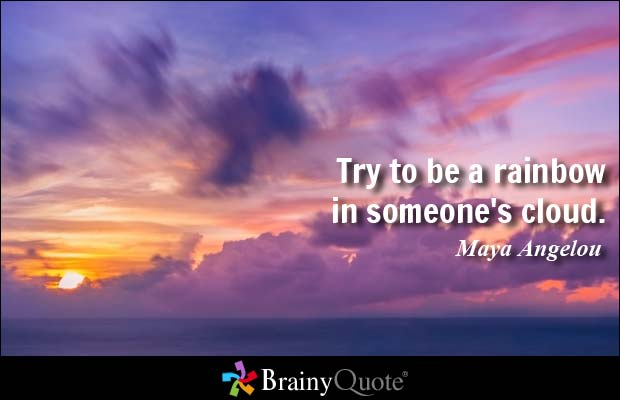
Be a Rainbow


Rainbow in the storms.

"A rainbow is a meteorological phenomenon that is caused by reflection,
refraction and dispersion of light
in water droplets resulting in a spectrum of light
appearing in the sky."
Wikipedia

They always show up in the sky opposite from the sun, appearing as multi-colored arcs.

rainbow: "a curved line of different colors...in the sky when the sun shines through rain"
Merriam-Webster Dictionary

Be a rainbow today to others drowning in tragic circumstances.

Let the Light shine through you to them.

Reflect truth, goodness, hope, and light.


"I refuse to accept despair as the final response to the ambiguities of history. I refuse to accept the idea that the 'isness' of man's present nature makes him morally incapable of reaching up for the eternal 'oughtness' that forever confronts him."
Martin Luther King Jr.


"But I am here to say to you this morning that some things are right and some things are wrong. Eternally so, absolutely so. It's wrong to hate, Its always been wrong and it always will be wrong."
Martin Luther King Jr.
from speech, "Rediscovering Lost Values," February, 1954


from current bumper sticker:
"God bless the whole world, no exceptions."

In the Light,

Daniel Wilcox

Tuesday, June 28, 2016

Learning to Listen--"Listening to the Other"

from MUSALAHA, a movement and organization working toward reconciliation
in Palestine/Israel

This also speaks to what we need in the U.S. now! between various political,
religious, and philosophical enemies.

"This weekend, June 17-18, 2016 was a highlight in my work in reconciliation. More often than not, recruiting for events is very challenging, and in our anything-can-change last-minute culture, it is difficult to get people to commit to a weekend-long meeting. Why would people take their precious weekends to stare into a mirror, and perhaps see things that need to change?"


"Listening to the Other"


"The Ahlan women’s group is different...We started the weekend with a barbeque, allowing families to join us for a few hours and be involved in what we are trying to accomplish..."

"Ronza, Musalaha’s West Bank Women’s Coordinator, and a facilitator in the Ahlan group, took us through a series of ice breaker games..it was her first time to lead one of Musalaha’s joint Israeli-Palestinian groups.
--

"Later, when the husbands left, our 28 women gathered and we started a teaching on “Listening to the Other,” which covered how to listen without preconceived notions or judgments...

"...on putting our thoughts on hold and being present in order to be able to hear the person in front of us. This conversation will only happen once. Be in the moment. You don’t get do-overs in life, so make the most of it and listen."

"Rula also taught us not to listen in order to answer."

"How many times do we sit on the edge of our chairs, hoping the other person takes a break to breathe so that we can start our rebuttal?"

"Toward the end of the conference, many of the women expressed their gratitude...Some women came from a small town outside of Ramallah – a place most Israelis have never heard of, let alone visited...."

-Hedva Haymov

"We seek to accomplish through the following:

To train women in leadership and reconciliation
To multiply our women’s Israeli and/or Palestinian groups in different regions
To impact our societies through community projects
To empower women through education, community development, democracy, networking, project management, and social change
To establish women’s groups in remote regions"

Read the whole story at
https://www.musalaha.org/articles/discovering-my-culture-by-learning-about-the-others-culture/
--


In the Light,

Daniel Wilcox

Friday, October 21, 2011

The Problem of Nationalism

Don't miss reading this powerful analysis of the biased conflict between President Abbas versus Prime Minister Netanyahu at the United Nations.


Again, nationalism and ideology trump truth and peace. If only we humans could be delivered from our human nation-self-centeredness.

from the website http://www.musalaha.org/default.asp
Musalaha (which means reconciliation in Arabic) is a ministry of reconciliation in the Middle East, established by Salim J. Munayer.

"In conflict situations, these two merge more closely, and each side has a historical narrative made up of truth and myth in which “our side” is portrayed in a positive light, and 'we' are always the protagonist hero and victim in 'our historical narrative.'

We saw elements of the Israeli and Palestinian historical narratives in the recent UN speeches. Abbas opened his speech emphasizing the Palestinians’ openness to previous negotiations, their tireless attempts at presenting their position, and their sincerity during the process.

But these endeavors proved futile, primarily as a result of Israel’s refusal to “commit to terms of reference” and its continued engagement in settlement activities.

From the beginning, Abbas, in effect, presented the Palestinians as the protagonists who are committed to a two-state solution, arguing that the Palestinians are the reasonable party as the Palestinians came to the negotiating table sincerely and were willing to compromise; the Israelis then are the antagonists, unreasonable and unwilling to compromise.

Throughout his speech he discussed the effects of the occupation on Palestinians, and recounts the Nakba of 1948 in which hundreds of thousands of Palestinians were exiled from their homes. In effect, he established the Palestinians as the victims of the conflict.

While renouncing terrorism and violence and affirming peaceful resistance to Israel, he never recognized the detrimental and traumatizing effects of violent Palestinian actions against Israel.

He talked about the Holy Land being a land holy to Muslims and Christians, pointedly excluding the Jewish people from their historical and religious connection to the Holy Land. In spite of the Palestinian people he detailed throughout his speech, he emphasized that the Palestinian people extend their hand to Israel for peace.


When Netanyahu gave his speech responding to Abbas, he constantly emphasized that Israel also extends its hand to the Palestinian people in peace. He stressed Israel’s constant hope for peace and its willingness to make sacrifices for peace, not only with the Palestinians, but with the rest of the Middle Eastern world.

In effect, he presented Israel as the peace-seeking protagonist, summoning the Palestinian people back to negotiations. He rhetorically reasoned with his audience, asking if they would wish for danger so close to their cities and families, reminding his audience of the resultant barrage of rockets that followed Israel’s withdrawal from Gaza.

He discussed the suffering of the Israeli people as a result of the rockets fired by Hezbollah in the north and Hamas from Gaza, presenting Israel as the victims of the conflict, never recognizing the detrimental and traumatizing effects of Israeli actions on Palestinians.

Consequently, he presented Israel as reasonable in its demand for military presence in the Occupied Palestinian Territories as he argued this is necessary for Israel’s security.

In effect, he showed that the Palestinians do not understand and are not reasonable in their requests. He argued that the primary issue is that the Palestinians refuse to recognize Israel as a Jewish state.


Toward the end of his speech, he discussed the ancient and undying Jewish connection to the land of Israel, but he pointedly failed to mention (thereby excluding) any comparable connection the Palestinian people have to the land, giving only a brief nod to them in closing as they “dwell” on the land.

Is it not interesting to note that reading between the lines, they are mirrors of each other?

One side is reasonable, the other unreasonable. One side is the aggressor, the other the victim.


Both sides claim to extend their hands in peace, yet they make no room for one another in their narratives. Neither side is willing to publicly acknowledge its contribution to and perpetuation of the conflict.

Both sides reference their religious heritage to justify their historical narrative...it is internally focused, often contains half-truths, and when the other side is addressed, it is morally excluded and devalued.

In order for us, both Israelis and Palestinians, to make progress toward reconciliation, we need to learn to truly listen to each other’s needs and be willing to recognize our own shortcomings.


The basic needs for mutual legitimization can be found in the speeches of both Netanyahu and Abbas.

Words of peace can be found in both speeches, but words of good will quickly dissipate when they are not coupled with acts of good will.

Instead of recognizing each other and respecting each other, they belittled and excluded each other. Instead of employing self-criticism, they criticized each other.

...we are all called to repent of our sins and shortcomings and seek peace, but this does not preclude us from reading the Bible in light of our own historical narratives...We can also read the Bible as an ethnic group, taking certain passages and using them for various purposes.

We should apply Biblical passages to our own lives, but we have to be careful that we do not do this in isolation. We have to be careful not to read the Bible selectively, overlooking passages that may be uncomfortable to us.

Above all, we are called to peace, love, and fellowship. We work for this every day and we hope you will continue to walk alongside us as we pursue peace, encourage love of our neighbors, and journey toward reconciliation. Musalaha is a non-profit organization that seeks to promote reconciliation between Israelis and Palestinians as demonstrated in the life and teaching of Jesus."

By Salim J. Munayer
Edited by A. Ben-Shmuel


[1] See “Stages of Reconciliation: Encounters between Israeli Jews and Palestinian Arabs” for more information http://musalaha.org/articleview.asp?offset=20&ID=9.


Let us live in peace, for peace, with peace
in the Light,

Daniel Wilcox