But look at how strange the list is considering that it was posted by nontheists this week on the Internet.
Many theists agree with all of these points, especially Friendly-oriented ones. Indeed, most of these points are why they are theists!
Quakers live in the Light with a very similar list.
#1
REASON, not superstition:
Great theistic scientists such Arthur Eddington, English astronomer, astrophysicist, philosopher, and mathematician would very strongly agree and support this phrase brainer!
For REASON is the CenterPoint of the Enlightenment and is the basis of science.
I strongly agree, am reason-centered, and hate superstition in all its forms.
If so many theists support "REASON, not superstition," what does this then have to do with atheism?!
The view that reason is reliable, that it qualifies as the best way for all humans to function would seem to show that it aligns with reality.
Thus it is probably inherent in reality, as much as math. It isn't a human construct, isn't an accident, and isn't a subjective cultural standard.
If so, that is a deep theistic outlook, not an atheistic one.
After all, reason was a center-post of great leaders such as Voltaire, Thomas Paine, Thomas Jefferson, Benjamin Franklin, etc.
All of them were committed to belief and trust in the God of reason, that reason is the way for humans to make decisions and to probe life, the cosmos, and all of reality.
As the Enlightenment's declarations emphasized, they based their views of justice, human rights, and truth on reality's God.
Arthur Eddington put it this way:
“The mind-stuff of the world is, of course, something more general than our individual conscious minds.... The mind-stuff is not spread in space and time; these are part of the cyclic scheme ultimately derived out of it.... It is necessary to keep reminding ourselves that all knowledge of our environment from which the world of physics is constructed, has entered in the form of messages transmitted along the nerves to the seat of consciousness...."
"Consciousness is not sharply defined, but fades into subconsciousness; and beyond that we must postulate something indefinite but yet continuous with our mental nature.... It is difficult for the matter-of-fact physicist to accept the view that the substratum of everything is of mental character. But no one can deny that mind is the first and most direct thing in our experience, and all else is remote inference."
— Eddington, The Nature of the Physical World, 276-81.
#2
ETHICS, not dogma:
The beginning of the Friends was ethically directed, not dogmatic or doctrinal; in fact the leaders strongly opposed religious dogma.
When Friends encountered injustice, immoral actions, and abuse, many of them stood up against such unethical behavior, no matter how much the perpetrators of the actions justified by them by religious or atheistic dogma.
And millions of ethical social activists of other worldviews have done so as well.
#3
RESPECT, not worship:
This is a more difficult statement to deal with because of the semantic problems. Friends and many other searchers for truth, justice, human rights, equality, reconciliation, peace would support the importance of RESPECT.
But here’s the conundrum: Quakers and many other theists base their support for respect in WORSHIP!
What so many of us mean by the term, “worship,” is probably--most likely--NOT
what the secularist meant by the term.
According to the Merriam-Webster Dictionary, worship means:
"the act of showing respect and love..."
Friends mean communion,
communication,
wonder,
transcendence,
spiritual intimacy...
The original writer of "...not worship" wasn't opposing "the act of showing respect and love...," nor was he against communication, intimacy, or wonder.
Rather, based on #1's statement, it seems likely that he does show a lot of respect, even love, for REASON and other important humanistic values.
It's the second part and secondary definitions of "worship" that secularists reject--
that of "...for a god, especially by praying with other people who believe in the same god... reverence offered a divine being or supernatural power.."
and
"...a form of religious practice with its creed and ritual."
Yes, nontheists think “worship” is a very negative term meaning:
delusion,
harmful, mean servile scraping,
and terrified fear of the dogmatic god of hellfire who is obsessed with his own glory.
Their rejection of "worship," is the rejection of doctrinal, creedal Christian, Muslim, and Hindu dogma; rejection of the Augustinian/Reformed/Sunni/Shia/Hindu God who is fixated on his own self.
They reject the divinity that, to quote Mahatma Gandhi, treats humans as “toys.” The same god who considers humankind as worthless, that every human infant is "in essence, evil" at conception, etc.
If that is the definition of “worship,” then we certainly are opposed to worship, too.
So were Enlightenment figures including Thomas Jefferson.
Maybe, we ought to abandon the word itself, because like other overused empty-bucket words--
ones which are used, abused, and misunderstood such as god, good, love, etc.—-
“worship” confuses rather than enlightens.
#4
COURAGE, not fear:
This would seem to be a universal agreed upon virtue by nearly all humans, though acting in courage, not fear, is entirely more difficult than supporting the action.
#5
FACT, not myth:
Again, this is another case of slimy semantics;-) Most people would agree if one means the common everyday definitions.
But again, applying this is more difficult for most people than one would ever imagine. Just look at the current presidential candidate campaign where most Americans are majoring in “myths,” advocating all sorts of ad hominem, distortions, plain propaganda, slander, and demeaning, untrue stories.
Much of the media is full of some of the most ridiculously superstitious, irrational, and unfactual information. And these "myth" spews come from many secular as well as religious leaders.
#6
MORALITY, not religion.
Ditto for what I explained in the numbers above.
It is very important to emphasize this separation, this rejection. Nearly always in the past, and everywhere now, religion is the source, cause, and inflictor of countless immoral attitudes, outlooks, laws, rituals, behaviors, and actions.
The most baffling aspect of this statement though is that many of the nontheists who claim to support “morality” actually think that no real ethics exist, that ethics are whatever humans choose them to be.
For instance, one nontheist leader stated, "There are no universal moral values."
Another, there is "no moral responsibility" not even for murdering and raping!
Instead, what many secularists mean by the term “morality” is only
“subjective preference,”
“like/dislike,”
“social construct,”
"cultural standards,"
and so forth.
They claim being opposed to slavery or rape or dishonesty, etc. is only similar to disliking a color such as blue or disliking chocolate!
According to them, morality is only an "opinion."
Other nontheists state that morality is a purposeless adaption of evolution, a survival mechanism.
From an interview with the brilliant biologist Richard Dawkins:
RD: My value judgment itself could come from my evolutionary past.
JB: So therefore it’s just as random in a sense as any product of evolution.
RD: You could say that, it doesn’t in any case, nothing about it makes it more probable that there is anything supernatural.
JB: Ultimately, your belief that rape is wrong is as arbitrary as the fact that we’ve evolved five fingers rather than six.
RD: You could say that, yeah.
--
Philosopher of Science professor Michael Ruse, makes similar statements:
“Morality is a biological adaptation, no less than are hands and feet and teeth … Morality is just an aid to survival and reproduction.”
-
American historian of science William Provine, professor of the history of science at Cornell University:
“Let me summarize my views on what modern evolutionary biology tells us, loud and clear, and I must say that these are basically Darwin’s views: there are...no purposive forces of any kind...
no ultimate foundation for ethics,
no ultimate meaning in life,
and no free will for humans either..."
--
Evolutionist Craig Palmer:
"That there is obviously some evolutionary basis to rape just like there is some evolutionary basis to all aspects of living things.
In the book we narrow it down to two plausible specific evolutionary reasons for why we are a species in which rape occurs. One is just a by-product of evolved differences between the sexualities of males and females.
Or, two, rape might be an adaptation. There might have been selection favouring males who raped under some circumstances in the past. And therefore there might be some aspects of male brains designed specifically to rape under some conditions.
An evolutionary reason is also known as the ultimate level of explanation. It’s really the question of why are we the way we are?
And the evolutionary answer is what selective forces favoured those traits in hundreds or thousands of past generations that we eventually end up with today.
A Natural History Of Rape: Biological Bases Of Sexual Coercion by Craig Palmer and Randy Thornhill, MIT Press
--
Thankfully, Palmer disagrees with evolution's adaption and states that he is strongly opposed to rape, that such a human action is immoral, but he does think that raping is a result of natural selection.
Thus it is uncertain and confusing how so very many secularists yet claim that human ethics result from evolution.
If both raping versus non-raping, slavery versus abolition, and all other actions of humans are ONLY the result of natural selection, how can anyone think that morality exists (except as one adaption of evolution)?
How could we humans come to an understanding as to which evolutionary adaptions are better than the other contrary ones?
Lastly, on a related topic, it would appear that when Palmer says "there is some evolutionary basis to all aspects of living things" he also means that the human fixation for "religion" is a result of natural selection, too!
#7
CLARITY, not delusion:
See above.
#8
GOOD, not god:
What?! How can there possibly be any good without god?
Again, everyone needs to define the terms. If one means the god of religion, then, for sure, good can exist without god.
Indeed, religion often opposes the good as in the case of Segregation in the United States and in the case of Apartheid in South Africa. And, currently, in the U.S. and many other countries throughout the world, religion supports inequality, injustice, and sexism.
One of the center-points of the Enlightenment is that religion opposes the GOOD.
But if one means by “not god” that reality—all of existence is completely meaningless, purposeless, then “good” in the sense of objective, true, and real can’t exist.
If there is no objective, true, and real “good,” then how could we humans do “good”?
That would be like saying there is NO COLOR, but please paint a drawing in red, since it is the best color!
Huh?
#9
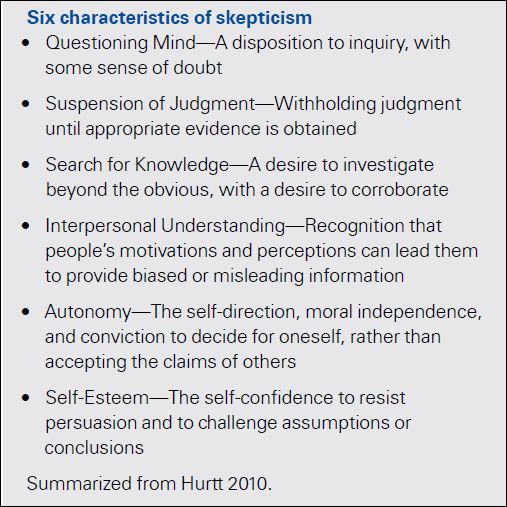
SKEPTICISM, not cynicism:
This is an extremely important value to hold. Merriam-Webster Dictionary--skeptic: “a person who questions or doubts…”
Such an attitude/behavior is the very first step to learning.
Without questioning, no learning is possible, only memorization and brain-washing.
And, who, except very negative, dysfunctional, or even nihilistic individuals wants to be a cynic?
Yes, I know there are actually a number of famous cynics,
but cynicism doesn’t bring hope,
doesn't rescue those who are suffering,
doesn't seek to free prisoners of conscience...
M-W-D- cynic: “a person who has negative opinions about other people...especially a person who believes that people are selfish, a faultfinding captious critic.
#10
RATIONALITY, not ideology:
Many a hand-clap to that:-) So many humans, even ones who manage to understand and reject superstition, religion, and illusion often yet get caught in the wiles of ideologies.
History is strewn with millions of corpses and devastated landscapes which show that this is all too true.
Every individual first needs to use his/her reason within to live rationally before trying to fix the mental attitudes/structures, behaviors, and wrong actions of others.
GREAT TO-DO LIST for humanity, for all of us humans!
I would add a few more essentials such as:
#11
EQUALITY, not sexism, racism, nationalism
#12
COMPASSION, not survival, natural selection,
#13
INCLUSION, not anti-immigration, prejudice,
#14:
NONVIOLENT PEACEMAKING, not war,
#15
NO-HARM FOOD, not meat-eating,
#16
WONDER, not materialism
#17
HOPE, not negativity
In every moment, choose to live closer to these essential center-points.
In the Light,
Daniel Wilcox