Our moral sensitivity about good versus evil on various actions didn’t come to us via tradition, revealed religion, our taste buds, the desire of our eyes, or some personal quirk, and certainly not from human instinct or matter and energy.
Moral concern, moral realism, is a transcendent “ought,” not a subjective “like” or “dislike.”
When it comes to the moral compass we are talking objective, transcendent truth. (Well, many humans are).
Other millions of modern people claim that morals, like personal preferences, are subjective, relative whether of the individual or a group or a nation.
But I wouldn’t characterize my own moral struggles of the last 67 years as battling over what I like or dislike. For instance, I like salmon, but can’t stand cow tongue (which I was required to eat as a kid growing up in Nebraska because we got over half a cow each year from our grandfather, and had to eat even the rubbery tongue and the gross tail). To each his own, when it comes to “like.”
In contrast, immoral actions (and attitudes) such as slavery, war, torture, molestation, rape, inequality, oppression, prejudice, greed, lust, promiscuity, jealousy, gossip, theft, lying, dishonesty, porn, obscenity, profanity, coveting, jealousy, selfishness, egotism, gossip, human sacrifice, cannibalism…most people will agree, (at least when these actions are done to them) that they are wrong.
In most cases of human moral choice, humans of the present generation don’t need to reinvent the moral wheel of truth. We’ve had the basics of moral realism since the some society’s early bronze age rules, and the Jewish 10 Commandments,
since Buddhism’s moral precepts, since Jesus’ Sermon on the Mount, 1 Corinthians 13, James, and many other passages from other holy books for thousands of years!
Where is the failing then?
In the carrying out of the moral truths, in the applying of the truths we expect others to observe in how we ourselves behave.
True sometimes, our moral blindness leads us astray such as when the Christian leader Robert E. Lee, for instance, spoke of how we should love our enemies as Christ said, yet was himself largely responsible for hundreds of thousands of humans being slaughtered, and many hundreds of thousands being wounded (and by devout Christians in the North who refused to let Southerners secede)!
What was their excuse?
Lee did this in defense against the invading army, the Union forces who invaded his state, his county, his home (even stealing family treasures).
Or when Christian Americans slaughter nearly half a million human civilians and declare this justified!
Or when Christian manufacturers put Bible verses on the barrel of assault guns which are used to kill others! Or when...
Or when ‘revealed religious leaders state that they should love their enemies personally, but that they ought to hate and destroy their enemies for God and country.
Yes, there are multi millions of cases back through religious histories including creedal Christian history which show humans of good will who violated the most basic of moral laws because they did it in the name of Jesus or...
And then there plenty of modern secular leaders who claim there are no moral truths.
In contrast, there are flawed moral leaders like Martin Luther King Jr. who state moral law is transcendent (fMLK—"I’m here to say to you this morning that some things are right and some things are wrong. Yes, eternally so, absolutely so. It’s wrong to hate. Yes, That’s right. It always has been wrong and it always will be wrong. (Amen) It’s wrong in America, it’s wrong in Germany, it’s wrong in Russia, it’s wrong in China. It was wrong in 2000 B.C., and it’s wrong in 1954 A.D. It always has been wrong, (That’s right) and it always will be wrong.
"(That’s right) It’s wrong to throw our lives away in riotous living. (Yeah) No matter if everybody in Detroit is doing it, it’s wrong. (Yes) It always will be wrong, and it always has been wrong. It’s wrong in every age and it’s wrong in every nation. Some things are right and some things are wrong, no matter if everybody is doing the contrary. Some things in this universe are absolute….And so long as we adopt this relative attitude toward right and wrong, we’re revolting against the very laws of God himself. (Amen)… This universe hinges on moral foundations… God has made the universe to be based on a moral law.” from “Rediscovering Lost Values”)
How can we know--prove--for sure that some actions are inherently evil, some transcendently good?
We can’t, unfortunately. We can’t prove the truth of moral realism. We can’t know. Not in the sense of factuality such as that 1,000 plus 1,000 equals 2,000 or in the sense that we can verify that the earth is a sphere, not a flat land.
In fact, even more disconcertingly, there is some experiential evidence which seems to deny the truth of moral realism.
But (with the exception of some hard Atheists, some Augustinian-Reformed and Islamic leaders), the vast majority of humans at present do think slavery is inherently evil—that the claim and act of “owning” another human being as a tool, as an object (rather than a person with inherent worth) is very immoral.
Such an institution as slavery denies equality. But we need to keep in mind that for thousands of years equality wasn’t considered truth. Even as recently as 150 years ago famous Calvinist theologians such as R.L. Dabney wrote extensively (even after the Civil War ended!) showing that there was nothing wrong with slavery.
Furthermore, secular leaders and scientists have long held that “equality” doesn’t exist in nature, that existence is based on “survival,” this most famously stated in the theory of natural selection.
Simply observe how cats treat birds or what happens when dogs, even on leases spot each other in the street—seldom any equality. It’s usually about power, not sharing.
Even in the Jewish Bible the law emphasized that if an owner of a slave beats his slave so the slave dies a couple of days later, there is to be no punishment of the owner because the slave was his “property” Exodus 21:20-21 NAB
And the Torah emphasizes that a Hebrew slave owner has the right to pass slaves down to his kids (Leviticus 25:44-46 HCSB.
But what then?
If there is no basis for objective ethics in nature and religious books often give the wrong answers, how do we go about living morally?
We discover and moral truth in a way like a tiny coral lives atop a coral reef:-)
In this existence we billions of human primates are but small finite coral on a great barrier coral reef which holds back the onslaught of Nature’s typhoon rampages, human instinctive desires bloated by selfishness and pride.
Deism, Fundamentalism, Friends-Brethren, key Scriptural passages on moral realism in such as 1 Corinthians 13, the Sermon on the Mount, James, etc.
Of course, this coral reef perception/awareness isn’t always upward and beautiful. As cited above, spiritual blindness can mislead us such as when Christians over the centuries have slaughtered millions of other humans in the name of Jesus Christ (such as when creedal Roman Catholic Bernard of C., who was known as the speaker of love called on Catholics to slaughter in the name of Jesus and when Martin Luther called on the princes to kill, slay, and “wash their hands in the peasants’ blood.” And, when most Christian leaders burned heretics at the stake, etc.
And, currently when “born-again evangelical Christians” advocate immoral actions in the name of politics which are contrary to Jesus’ clear moral truths.
Still, over all in every generation, some humans do experience the blessed hope of moral realism and share moral good actions and oppose all the immoral and unjust actions.
Let’s take a more specific look at the issue of equality and how I ended up, a tiny living coral in the early 1950’s coming to a strong stand for equality, even though so many millions of Christians during that time actually were very against equality. And, even today in the 21st century the Russian Orthodox Church opposes human equality and justify the slaughter of innocent Ukrainian civilians!
It’s all about looking backward down the reef of moral realism.
Secondly, this question is one of theodicy, too.
We could ask why God didn’t supply humans with accurate moral guidance from the beginning some 200,000 years ago?
But then, God. also didn’t give us knowledge of disease and how to overcome it, and thus protect billions of humans from excruciating deaths in epidemics such as the Black Plague.
For whatever reason, God requires us human primates to seek, and study, and find solutions on our own. Moral realism is a ‘coral reef’ experience to be sought with reason, experience, intuition, and history.
Like Martin Luther King pointed out, “I refuse to accept despair as the final response to the ambiguities of history. I refuse to accept the idea that the 'isness' of man's present nature makes him morally incapable of reaching up for the eternal 'oughtness' that forever confronts him.”
In the LIGHT,
Daniel Wilcox
Showing posts with label relative. Show all posts
Showing posts with label relative. Show all posts
Monday, September 29, 2025


Thursday, December 7, 2017
True Ethics in the Midst of Left and Right Hypocrisy
Seeking true ethics is one of the most difficult tasks any of us human primates can do.
And it becomes much more difficult when human leaders display hypocrisy and contradictions when speaking of ethics.

And that so many secularists are claiming that all ethics are “subjective,” “relative,” only “personal” or cultural “preferences,” only a matter of “like or dislike,” that slavery, rape, slaughter, dishonesty aren’t objectively wrong. And that there are no human rights. According to these atheists, rights, equality, liberty, etc. are “myths.”
Is it any wonder that millions humans are confused when it comes to the questions of "ought"?
Or consider the strange anomaly of so many religious leaders in 2017 claiming that various immoral or unjust actions are only wrong because such actions contradict what God has commanded, Divine Command Theory. If God changes his commands (as the Deity often did in the past), then true ethics change.
Worst of all many Christian, Muslim, and Hindu leaders claim God--before the universe began--pre-planned every murder, every rape, every molestation, every natural evil disaster for God's-self! And if you question such a gargantuan horror, they ask who do you think God is?!
God can do whatever he wills because God is God!
Forget such horrific beliefs.
Eliminating those majority views at least narrows the multi-pronged choices staring at us at every moment when we need to choose.
Now for coming the New Year of 2018, Let's seek the Light, seek the Life, seek the Good, seek the Just.
But how does one do so? The difficulty, the Good, is in the details.
One online commentator challenged me to provide a better method.
First, it would appear to most people who study history that neither religion nor atheism hasn't provided a good code of ethics. On the contrary such ideolgoies have committed mass slaughter and supported everything from slavery and dishonesty to theft and torture, to discrimination and persecution. No, Christianity hasn't provided a reliable ethical guide. Check out books such as Jesus Wars and The Great and Holy War: How W.W. l became a Religious Crusade by Phillip Jenkins. And read the critical commentaries on Islam and its horrific history.
Second, the human conscience (except in sociopaths) declares we are to do right, to do the good, but doesn't usually clarify what or how. In fact in history, the most evil actions were committed not by immoral choosers, but by conscientious, dutiful humans!
Let's get an eagle's overview of the mountainous region of ethics:

#1 Probably, the spiritual side of the Enlightenment has achieved the most ethically.
Since then a majority of humans have come to give, at least give lip service, to the ideals of human rights, equality, justice and to condemn the slaughter of innocent humans, poverty, prejudice, torture, slavery, and so forth.

Reason has shown to be more true, more effective, more real than any religious dogma ever was.
However, even in reason and transcendent claims there are doubts and problems and dilemmas. Fortunately, most humans seldom have to deal with the extremes such as the trolley car dilemma and other difficult choices.
Indeed, I wonder why so many ethical skeptics immediately jump to the most extreme difficult examples when the subject of morality is brought up.
In general, for instance, it would seem that honesty and justice are reliable goals, even if in a few severe situations, one might choose an action of dishonesty or injustice in order to save human lives.
But if I moved back to the Middle East and soon was faced with a dire threat by HAMAS or Hezbollah, and chose to lie to protect innocent Jewish civilians,
my lie still wouldn't be true.
Later after human rights organizations got the innocent individuals safely out of the clutches of "Godly" religious organizations, I ought to then print an acknowledgment of my dishonest statement, explaining that I know all lying is wrong, and that I had only told the lie to protect innocent lives.
Too often humans quickly jump to the immoral choice--declaring it good--when encountering a difficult trial. For example Americans constantly condemn Muslims in the Middle East for using torture and terrorism, but quickly defend the U.S. government when it tortures and slaughters.
Let's take non-religious leaders' most extreme example: Ought a good human--if there are no other possible options--murder or rape to defend innocent people?
No.
When making ethical choices, the means is part of the end. When you pick up the immoral ethical stick on one end you get the other, too, even if your intentions are good.
Just for the sake of illustration, what if a U.S. Seal could only save a young Syrian or Afghan girl from being tortured and murdered by Muslim jihadists by pretending to attack and rape her?
Such an undercover individual might choose to rape the girl because he thinks raping her isn't as evil as letting the Islamic State thugs behead or stone her.
HOWEVER, his act of rape--even though done with good intentions--still will harm the girl and is very wrong.
One evil in response to another evil doesn't make a good.
Never.
In the Light,
Daniel Wilcox
Sunday, June 11, 2017
The Whole Human Versus the One-Angled Human
#1 Usually orthodox Christians, Muslims, Jews, and other religionists say they live only by faith (usually narrowly defined)-- belief in the divine, eternal truth of only their own ancient literature by which all other human values must be judged, that all other views are "made-up" or "demonic" or based in "human pride" and "selfishness."

According to them, each human has no “inherent” worth, value, and meaning. Every human and everything else is “worthless” except for whom and what God has given value to in his foreordination, sovereignty and hidden will.
All events in existence including natural disasters, disease, war, famine, crime, and evil etc. are the result of the sovereign will of God.
VERSUS
#2 Usually hard Atheists say they live only by science and reason (usually narrowly defined)--that all other human values are subjective, relative, “made-up,” “constructed,” only “ personal opinion” or “cultural preference” that there are no inherent ethics, no human “rights,” no “justice,” no valid aesthetics, no “better” culture or social framework.
According to them, each human has no “inherent” worth, value, and meaning. Every human and everything else is “worthless” because there is no essential or ultimate reality. Nothing but matter and energy moving eternally.

All events in existence including natural disasters, disease, war, famine, crime, and “so-called evil” are the result of a meaningless, purposeless rigid determinism. All humans are "puppets" and have no choice.
Do you see the irony of this double-mirror, each worldview, perspective negating the other yet almost exactly the mirrored reflection of the other in many significant ways?
FURTHERMORE:
Of course, most religionists don’t only live by “faith.”
They regularly live by “science and reason” when it comes to illness, mechanical failure, running their business, etc.
Most of them don’t live “only by faith.” When they are sick, they consult a doctor, go in for an operation, when their vehicle breaks down, they use tools or take it to a mechanic, when they start a business, they employ an accountant, etc.
And, of course, most atheists don’t live “only by science and reason.”
They regularly support the police and serve on juries which are allegedly based in justice, not subjectivity, that if criminals break into their house or assault their children, it’s not just “subjective,” “relative,” or “made up.”
And they usually send their kids to formal schools be educated in the humanities and aesthetics as well as science.
They don’t assume that the latest scam, National Inquirer news, or scrawl on the side of a building are “equal” to an historical study, meticulously honest fair news or the classics in the library.

Essential or Inherent Humanism seeks to counter both of these ‘one-angled’ extremes which distort reality.
But the explanation of that is for the next post:-)
In the Light,
Daniel Wilcox
Thursday, December 31, 2015
Howard H. Brinton's Insights and Warnings: the Modern World/Quaker Movement 64 Years Later
"Unless man [humanity:-*] can develop his[her] interior dimensions in such a way as to form a dyke against the floods from the world without, he will become engulfed in the world of nature and sink back to the subhuman level whence he long ago emerged."
Howard H. Brinton, Friends for 300 Years, 1952

How true this warning has become. In his brilliant book in 1952,
Friends for 300 Years, Brinton demonstrated not only insight
but prophetic foresight as to the future dangers of lopsided and
even delusionary philosophy/religion/ethics.
Surely, I need not document in detail more than I already have
(in the past few months of commentaries and reflections on this
blog) how modern American society--despite a few advances
including upholding rights for all humans--has seeped tragically
into relativism and subjectivism in ethics,
how so many smart educated humans
now claim that ethics are only
"personal preferences."
As bad as the 1950's were in many ways, most Americans including
Friends thought that there was objective good and evil, ultimate
truth, and that the Light is real, not a subjective experience.
Not so for many now in the darkening end of 2015.
Whew...that's the bad news.
But Brinton in the book offers
the complex answer of the Good News
as well.
According to Brinton, there are 4 key essentials in true religion:
"The best type of religion is one in which the mystical, the evangelical, the rational, and the social are so related that each exercises a restraint on the others.

--Too exclusive an emphasis on mysticism results in a religion which is individualistic, subjective, and vague;
--too dominant an evangelicalism results in a religion which is authoritarian, creedal, and external;
--too great an emphasis on rationalism results in a cold intellectual religion which appeals only to the few;
--too engrossing a devotion to the social gospel results in a religion which, in improving the outer environment, ignores defects in the inner life which cause the outer disorder.
In Quakerism the optimum is not equality in rank of the four elements. The mystical is basic. The Light Within occasions the acceptance or rejection of a particular authority, reason, or service." (pages 203-205, Friends for 300 Years by Howard H. Brinton, Pendle Hill)
--
While agreeing with Brinton so much in this book, I do disagree with his last statement--that "The mystical is basic. The Light Within..."
I'm not disagreeing with him or any other thinker in the sense that ultimate reality doesn't precede the rational but that for so many Quakers and other humans now, "mystical" has become another "empty-bucket" word which means a million different things. And has become primarily to mean something individualistic and postmodern.
If everyone were to use the term "mystical" in the Merriam-Webster Dictionary sense, then I would agree:
"Full Definition of mystical
1
a : having a spiritual meaning or reality that is neither apparent to the senses nor obvious to the intelligence...
b : involving or having the nature of an individual's direct subjective communion with God or ultimate reality..."
In the Light,
Daniel Wilcox
--
*How dated 60-year-old books seem now with their un-egalitarianism language. It isn't surprising when one sees it in most books, but to see the old usage in a Friends' seminal work does shock, since Friends have emphasized equality to one degree or another for over 365 years. On the other hand, the "man," and "he's" were linguistic convention, probably something that Brinton didn't even notice.
Howard H. Brinton, Friends for 300 Years, 1952
How true this warning has become. In his brilliant book in 1952,
Friends for 300 Years, Brinton demonstrated not only insight
but prophetic foresight as to the future dangers of lopsided and
even delusionary philosophy/religion/ethics.
Surely, I need not document in detail more than I already have
(in the past few months of commentaries and reflections on this
blog) how modern American society--despite a few advances
including upholding rights for all humans--has seeped tragically
into relativism and subjectivism in ethics,
how so many smart educated humans
now claim that ethics are only
"personal preferences."
As bad as the 1950's were in many ways, most Americans including
Friends thought that there was objective good and evil, ultimate
truth, and that the Light is real, not a subjective experience.
Not so for many now in the darkening end of 2015.
Whew...that's the bad news.
But Brinton in the book offers
the complex answer of the Good News
as well.
According to Brinton, there are 4 key essentials in true religion:
"The best type of religion is one in which the mystical, the evangelical, the rational, and the social are so related that each exercises a restraint on the others.

--Too exclusive an emphasis on mysticism results in a religion which is individualistic, subjective, and vague;
--too dominant an evangelicalism results in a religion which is authoritarian, creedal, and external;
--too great an emphasis on rationalism results in a cold intellectual religion which appeals only to the few;
--too engrossing a devotion to the social gospel results in a religion which, in improving the outer environment, ignores defects in the inner life which cause the outer disorder.
In Quakerism the optimum is not equality in rank of the four elements. The mystical is basic. The Light Within occasions the acceptance or rejection of a particular authority, reason, or service." (pages 203-205, Friends for 300 Years by Howard H. Brinton, Pendle Hill)
--
While agreeing with Brinton so much in this book, I do disagree with his last statement--that "The mystical is basic. The Light Within..."
I'm not disagreeing with him or any other thinker in the sense that ultimate reality doesn't precede the rational but that for so many Quakers and other humans now, "mystical" has become another "empty-bucket" word which means a million different things. And has become primarily to mean something individualistic and postmodern.
If everyone were to use the term "mystical" in the Merriam-Webster Dictionary sense, then I would agree:
"Full Definition of mystical
1
a : having a spiritual meaning or reality that is neither apparent to the senses nor obvious to the intelligence...
b : involving or having the nature of an individual's direct subjective communion with God or ultimate reality..."
In the Light,
Daniel Wilcox
--
*How dated 60-year-old books seem now with their un-egalitarianism language. It isn't surprising when one sees it in most books, but to see the old usage in a Friends' seminal work does shock, since Friends have emphasized equality to one degree or another for over 365 years. On the other hand, the "man," and "he's" were linguistic convention, probably something that Brinton didn't even notice.
Monday, December 28, 2015
Seeking True Ethics in the New Year


Besides such a wonder-working miracle--finding true ethics--I will also explain the future of the multitverse in the billion-year'd future and what stone age men thought about women;-)
Seriously, seeking true ethics is one of the most difficult tasks any of us can choose. Given that so many non-religious leaders in 2015 (and before) have stated that ethics are only "subjective," "relative," "personal preferences," and not "real," is it any wonder that many humans are confused when it comes
to the questions of "ought"?
Or consider the strange anomaly of so many religious leaders in 2015 claiming that various immoral or unjust actions are only wrong because such actions contradict what God has commanded, Divine Command Theory. If God changes his commands (as the Deity often did in the past), then true ethics change.
And even worse, so many church leaders claim God will call you to commit immoral actions.
Worst of all many Christian, Muslim, and Hindu leaders, again, claimed God--before the universe began--pre-planned every murder, every rape, every molestation, every natural evil disaster for God's-self! And if you question such a gargantuan horror, they ask who do you think God is?!
God can do whatever he wills because God is God!
To Hell/Abyss/Sheol with all such terrible claims.
Eliminating those majority views at least narrows the multi-pronged choices staring at us at every moment when we need to choose.

Now for the New Year:-) Let's seek the Light, seek the Life, seek the Good, seek the Just.
But how does one do so? The difficulty is in the details.
On Christmas Eve one online commentator challenged me to provide a better method than the Christian religion has provided in the last 2,000 years.
First, it would appear to most people who study history that religion hasn't provided a good code of ethics. On the contrary it has done a horrific job supporting everything from slavery and slaughter to discrimination and persecution. No, Christianity hasn't provided a reliable ethical guide. Check out books such as Jesus Wars by Phillip Jenkins or some of the recent critical commentaries on Islam.
BUT
that doesn't mean anyone else has come up with a sure method of finding what is "oughtfully" true.
The human conscience (except in sociopaths) declares we are to do right, to do the good, but doesn't usually clarify what or how. In fact in history, the most evil actions were committed not by immoral choosers, but by conscientious, dutiful humans!
Let's get an eagle's overview of the mountainous region of ethics:
#1 Probably, the spiritual side of the Enlightenment has achieved the most ethically.
Most humans have come to at least give lip service to the ideals of human rights, equality, justice and to condemn the slaughter of innocent humans, poverty, prejudice, torture, slavery, and so forth. Reason has shown to be more true, more effective, more real than any religious dogma ever was.

However, even in reason and transcendent claims there are doubts and problems and dilemmas. Fortunately, most humans seldom have to deal with the extremes such as the trolley car dilemma and other difficult choices.
Indeed, I wonder why so many ethicists immediately jump to the most extreme difficult examples when the subject of morality is brought up.
In general, for instance, it would seem that honesty and justice are reliable goals, even if in a few severe situations, one might choose dishonesty and injustice in order to save human lives.
After all, if I moved back to the Middle East and soon was faced with a dire threat by HAMAS or Hezbollah, and chose to lie to protect innocent Jewish civilians,
my lie still wouldn't be true.
Later after human rights organizations got the innocent safely out of the clutches of "Godly" religious organizations, I ought to then print an acknowledgment of my dishonest statement.
Too often humans quickly jump to the immoral choice--declaring it good--when encountering a difficult trial. For example Americans constantly condemn Muslims in the Middle East for using torture and terrorism, but quickly defend the U.S. government when it tortures and slaughters.
Let's take non-religious leaders' most extreme example: Ought a good human--if there are no other possible options--murder or rape to defend innocent people?
No.
When making ethical choices, the means is part of the end. When you pick up the immoral ethical stick on one end you get the other, too, even if your intentions are good.

Just for the sake of illustration, what if a U.S. Seal coulc only save a young Iraqi girl in Ramadi from being tortured and murdered by raping her?
Such an undercover individual might choose to rape the girl because he thinks raping her isn't as evil as letting the Islamic State thugs behead or stone her.
HOWEVER, his act of rape--even though done with good intentions--still will harm the girl and is therefore wrong.
Cliche warning: One evil in response to another evil doesn't make a good. Never.
#2 Keep in mind that many ethical truisms from the ancient past don't need to be jettisoned, probably not even questioned.
Contrary to what various thinkers such as Michael Shermer and Valire Tarico state, the 10 Commandments of Jews, Christians, and Muslims are a very good start toward seeking true ethics, especially when updated with the new ethical insights of the Enlightenment.

10. Don't covet. Don't inordinately desire what belongs to another person.
Sounds like a good start toward community and well-balanced mental/emotional health for each individual.
9. Don't lie. Honesty is the basis of so many other ethical truths. Heck, Enlightenment actions such as scientific method and reason can't even work if adherents practice lying.
8. Don't steal. Think how many wars and conflicts would never occur if humans didn't steal. The tragic events in Palestine/Israel would never have happened if in the past (and at present) Jews, Muslims, and Christians hadn't stolen.
7. Don't commit adultery. In Shermer's new book, The Moral Arc, advocating good ethics based on reason, he writes that this commandment "doesn't take into account the wide variety of circumstances in which people find themselves."
What sort of weak reasoning is that?!
Ethical codes are meant to guide us, not to excuse us, and aren't to be controlled by circumstances in which we "find ourselves" but to CHANGE those circumstances and change us!
On the contrary, circumstances often lead humans to "lose themselves." Think of how many famous leaders in the last 30 years have "lost themselves" and caused all manner of harm to others because they committed adultery.
Consider how many families have been broken apart because one spouse was disloyal/betrayed the other.


To be continued--
In the Light,
Daniel Wilcox
Sunday, December 13, 2015
Doubtful about Creation versus Atheism?
Have you heard the joke about the Quaker philosopher, Atheistic biologist, and Theistic scientist who met and all disagreed at the same time;-)?
From a life-time of studying the issues of science and cosmology versus religion and philosophy, here’s my short list of some of the best books to study in our search for what is true:
#1: The Ancestor’s Tale by Richard Dawkins
 Dawkins’ mastery of biology and evolutionary history
is amazing. This is one of the very best 10 books
published in science. It’s sad, however, that such
a brilliant thinker has a limited and skewed
understanding of philosophy, cosmology, and religion.
Most tragic is that Dawkins thinks ethics are
relative and subjective. In an interview,
he even stated that rape is only
a subjective preference!
#2: Finding Darwin's God: A Scientist's Search for Common
Ground Between God and Evolution by Kenneth R. Miller
Miller is an award-winning evolutionary cell biologist
and professor at Brown University who has defended
the science of evolution against creationism in
U.S. courts.
In this lucidly written book on evolution,
Miller disproves creationism. But then contrary to
the views of Dawkins, Dennett, and other scientists
who are Atheists, Miller goes onto
to argue for Theism!

#3 Darwin's Dangerous Idea: Evolution and the Meanings
of Life by Daniel C. Dennett
 This magisterial work would probably have been better
titled how Darwinian evolution shows that Life has no
meaning. Don't miss reading this tome.
No matter what your philosophical view, you will never
be the same upon finishing and reflecting on its key
ideas and evidence.
#4: Rock of Ages by Stephen Jay Gould
(Or any of his other many books)
 Read any of Stephen Jay Gould's pity studies in science
and the history of science. His infamous view of the
relationship of science and religion called NOMA
(Non-overlapping magistereria) emphasizes that there
is no conflict between the two contrary fields.
According to this brilliant evolutionist, this is
because science and religion deal with very different
issues--biology with the natural world,
but religion with the world of values and ethics.
NOMA has led to all sorts of strong reactions by thinkers
on all sides of the whole controversy. Gould's important
thinking is not to be missed even if you disagree. See
especially "Non-Overlapping Magisteria" in
Natural History Magazine, beside his book,
(with its a play on words of religion, science
and history), Rock of Ages.
#5: Tower of Babel: The Evidence Against the New Creationism
by Robert T. Pennock
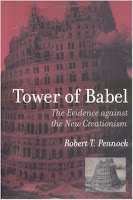
In this case, we hear from Pennock who is a philosopher
of science at Michigan State University rather than from
scientists.
Pennock is a Quaker and a theist, but one who
strongly supports evolutionary views against both young
earth creationism and Intelligent Design scientists. A vey
intriguing book, which surely will get your hackles up no
matter what you think:-)
What books, articles, or documentaries do you think ought to be added to the list?
In the Light,
Daniel Wilcox
From a life-time of studying the issues of science and cosmology versus religion and philosophy, here’s my short list of some of the best books to study in our search for what is true:
#1: The Ancestor’s Tale by Richard Dawkins

is amazing. This is one of the very best 10 books
published in science. It’s sad, however, that such
a brilliant thinker has a limited and skewed
understanding of philosophy, cosmology, and religion.
Most tragic is that Dawkins thinks ethics are
relative and subjective. In an interview,
he even stated that rape is only
a subjective preference!
#2: Finding Darwin's God: A Scientist's Search for Common
Ground Between God and Evolution by Kenneth R. Miller
Miller is an award-winning evolutionary cell biologist
and professor at Brown University who has defended
the science of evolution against creationism in
U.S. courts.
In this lucidly written book on evolution,
Miller disproves creationism. But then contrary to
the views of Dawkins, Dennett, and other scientists
who are Atheists, Miller goes onto
to argue for Theism!

#3 Darwin's Dangerous Idea: Evolution and the Meanings
of Life by Daniel C. Dennett

titled how Darwinian evolution shows that Life has no
meaning. Don't miss reading this tome.
No matter what your philosophical view, you will never
be the same upon finishing and reflecting on its key
ideas and evidence.
#4: Rock of Ages by Stephen Jay Gould
(Or any of his other many books)

and the history of science. His infamous view of the
relationship of science and religion called NOMA
(Non-overlapping magistereria) emphasizes that there
is no conflict between the two contrary fields.
According to this brilliant evolutionist, this is
because science and religion deal with very different
issues--biology with the natural world,
but religion with the world of values and ethics.
NOMA has led to all sorts of strong reactions by thinkers
on all sides of the whole controversy. Gould's important
thinking is not to be missed even if you disagree. See
especially "Non-Overlapping Magisteria" in
Natural History Magazine, beside his book,
(with its a play on words of religion, science
and history), Rock of Ages.
#5: Tower of Babel: The Evidence Against the New Creationism
by Robert T. Pennock

In this case, we hear from Pennock who is a philosopher
of science at Michigan State University rather than from
scientists.
Pennock is a Quaker and a theist, but one who
strongly supports evolutionary views against both young
earth creationism and Intelligent Design scientists. A vey
intriguing book, which surely will get your hackles up no
matter what you think:-)
What books, articles, or documentaries do you think ought to be added to the list?
In the Light,
Daniel Wilcox
Subscribe to:
Posts (Atom)