Certainty—at least the intense feeling, the passion for that state of mind, that mental obsession, that human idol—is a dear longing, seemingly in nearly every human.
Probably, maybe, it was the devil in the bloody details which led at least 3 smart, fairly rich, well-educated young men in Bangladesh to slaughter civilians in a café for Allah.
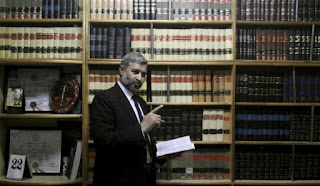
#1 A handout picture released by the King Faisal Foundation on March 1, 2015 shows Saudi King Salman bin Abdul Aziz left, presenting Zakir Naik, president of the Islamic Research Foundation in India, with the 2015 King Faisal International Prize for Service to Islam in Riyadh. (AFP/King Faisal Foundation)
One of the jihadists, Rohan Imtiaz, in the Dhaka restaurant attack last week put up a Facebook message of Zakir Naik's statement about Muslim jihad:
“If he is fighting enemies of Islam, I am for him. I don’t know him personally. If he terrorizing America, is the biggest terrorist, I am with him."
"Every Muslim should be a terrorist. The thing is that if he is terrorizing a terrorist, he is following Islam.”
Zakir Naik
www.Peaceforall.org.uk
#2 Yet the Muslim leader Zakir Naik, like other Muslim leaders, claims to be against killing!
How does that figure?
Because most Muslims believe they have a duty to kill or punish those who have “created corruption in the land,” a vague phrase that can mean a wide variety of actions, as any study of Sharia Law in Muslim countries shows.
Check out the news of the 700 lawyers working for the death penalty for individuals accused of demeaning the name of Muhammad:
"Leader of the Khatm-e-Nubuwwat Lawyers' Forum, a conservative alliance of lawyers offering free legal advice for anyone filing a blasphemy case, Ghulam Mustafa Chaudhry poses for a portrait at his office in Lahore, Pakistan February 22, 2016."
"The stated mission of the Khatm-e-Nubuwwat Lawyers' Forum and its leader Ghulam Mustafa Chaudhry is uncompromising: to use its expertise and influence to ensure that anyone insulting Islam or the Prophet Mohammad is charged, tried and executed."
"Whoever does this (blasphemy), the punishment is only death. There is no alternative," Chaudhry told supporters crammed into his small office behind the towering red-brick High Court building in the eastern city of Lahore."
http://www.reuters.com/article/pakistan-blasphemy-lawyers-idUSKCN0W905G
#3 Eric Hoffer, author of
The True Believer, has answers:
“Absolute faith corrupts absolutely."
"The true believer is apt to see himself as one of the chosen...who is destined to inherit...heaven, too."
#4 Naik is a medical doctor who has become a very popular media speaker for Islam, has more than 100 million viewers,
and has been called the “rock star” of Islam.
However, he has been banned from public speaking in United Kingdom, Canada, and Malaysia.
#5 The list of café killers includes Nibras Islam, Rohan Imtiaz, Meer Saameh Mubasheer, Khairul Islam, and Shafiqul Islam.
Why did they lay aside their college educations,
their relationships, their families,
their social life, their friends,
their fun activities,
their interests, their passions,
their ethical intuitions,
even the usual understanding of religious ethics
that one isn’t to kill women?
After all, Muhammad, when he had at least 500 Jewish men beheaded, didn’t execute the women and children but had them sold into slavery.
Yet so many thousands of Muslim young men, now, many of them from middle or upper-class background, and well-educated, have gone off to jihad and killed hundreds of thousands of other humans!
They abandon what most humans want--
LAY all that down!
And often commit war-suicide, before they have hardly even begun adulthood,
in order to kill for Allah, for the God of 99 names,
to destroy young men and women at malls,
in heretical mosques,
in churches,
anywhere non-orthodox Muslims live.
#6 After shouting “God is Great,”
these 5 ran in and asked individuals
if they were Muslims
and demanded they recite the Quran.
If not, they hacked them down.
#7 The killers seem happy, totally guilt-free,
indeed, proud and dutiful.
They are technologically smart and upload photos during their attacks!
How could this impossible, horrific, tyranny of murder possibly happen?
Do these smart, happy-looking individuals look like the sort who would kill innocent civilians eating at a café?
#8 Eric Hoffer gives answers:
“Absolute faith corrupts absolutely.
To be in possession of an absolute truth is to have a net of familiarity spread over the whole of eternity.
There are no surprises and no unknowns. All questions have already been answered, all decisions made,
all eventualities foreseen. The true believer is without wonder and hesitation.
The act of self-denial seems to confer on us the right to be harsh and merciless towards others.
The effectiveness of a doctrine does not come from its meaning but from its certitude.
No doctrine however profound and sublime will be effective unless it is presented
as the embodiment of the one and only truth.
It must be the one word from which all things are and all things speak.
The impression somehow prevails that the true believer, particularly the religious individual,
is a humble person. The truth is that the surrendering
and humbling of the self
breed pride and arrogance.
The true believer is apt to see himself as one of the chosen...who is destined to inherit...heaven, too.
#9 Three of the innocent slaughtered by the Muslim killers:
He who is not of his faith is evil; he who will not listen shall perish.
There is no doubt that in exchanging a self-centered for a selfless life we gain enormously in self-esteem. The vanity of the selfless, even those who practice utmost humility, is boundless.
…a mass movement, particularly in its active, revivalist phase, appeals not to those intent on bolstering and advancing a cherished self, but to those who crave to be rid of an unwanted self.
A mass movement attracts and holds a following not because it can satisfy the desire for self-advancement, but because it can satisfy the passion for self-renunciation.
There is no doubt that in exchanging a self-centered for a selfless life we gain enormously in self-esteem.
[The true believer’s] innermost craving is for a new life - a rebirth - or, failing this, a chance to acquire new elements of pride, confidence, hope, a sense of purpose and worth by identification with a holy cause.
An active mass-movement offers them opportunities for both. If they join the movement as full converts they are reborn to a new life in its close-knit collective body...
Or if attracted as sympathizers they find elements of pride, confidence, and purpose by identifying with the efforts, achievements, and prospects of the movement.
A mass movement attracts and holds a following not because it can satisfy the desire for self-advancement, but because it can satisfy the passion for self-renunciation.
It is obvious, therefore, that in order to be effective, a doctrine must not be understood, but has rather to be believed in.
We can be absolutely certain only about things we do not understand.
Self-surrender...is...the source of a mass-movement’s unity and vigor, is a sacrifice...
To know a person's religion, we need not listen to his profession of faith but must find his brand of intolerance.
The taint inherent in absolute power is not its inhumanity but its anti-humanity.
The rejection of approximations and the insistence on absolutes are the manifestation of a nihilism that loathes freedom, tolerance, and equity.
Both absolute power and absolute faith are instruments of dehumanization. Hence absolute faith corrupts as absolutely as absolute power.
Here, as elsewhere, the technique of a mass movement aims to infect people with a malady and then offer the movement as a cure.
An effective mass movement cultivates the idea of sin. It depicts the autonomous self not only as barren and helpless but also as vile.
To confess and repent is to slough off one’s individual distinctness and separateness, and salvation is found by losing oneself in the holy oneness of the congregation.
...whether or not [religions such as Islam] develop into mass movements depends less on the doctrine they preach and the program they project than on the degree of their preoccupation with unity and the readiness for self-sacrifice.
We join a mass movement to escape individual responsibility…"to be free from freedom”…Had they not joined…in order to be free from responsibility?
We are ready to sacrifice our true, transitory self for the imaginary eternal self we are building up, by our heroic deeds, in the opinion and imagination of others.
We can be absolutely certain only about things we do not understand. A doctrine that is understood is shorn of its strength.
Self-righteousness is a loud din raised to drown the voice of guilt within us.
Passionate hatred can give meaning and purpose to an empty life. Thus people haunted by the purposelessness of their lives try to find a new content not only by dedicating themselves to a holy cause but also by nursing a fanatical grievance. A mass movement offers them unlimited opportunities for both.
There can be no mass movement without some deliberate misrepresentation of facts.
The act of self-denial seems to confer on us the right to be harsh and merciless toward others.
To the frustrated, freedom from responsibility is more attractive than freedom from restraint. They are eager to barter their independence for relief of the burdens of willing, deciding and being responsible for inevitable failure.
They willingly abdicate the directing of their lives to those who want to plan, command and shoulder all responsibility.
Every extreme attitude is a flight from the self.
He turns away from an unpromising self and plunges into the pursuit of pride — the explosive substitute for self-esteem.
All social disturbances and upheavals have their roots in crises of individual self-esteem, and the great endeavor in which the masses most readily unite is basically a search for pride.
Pride is a sense of worth derived from something that is not organically part of us, while self-esteem derives from the potentialities and achievements of the self.
We are proud when we identify ourselves with an imaginary self, a leader, a holy cause, a collective body or possessions.
There is fear and intolerance in pride; it is sensitive and uncompromising.
Activists of Pakistani religious group Sunni Tehreek demanding executions of court sentences given under the blasphemy law...
The less promise and potency in the self, the more imperative is the need for pride. The core of pride is self-rejection.
A doctrine insulates the devout not only against the realities around them but also against their own selves.
The fanatical believer is not conscious of his envy, malice, pettiness and dishonesty. There is a wall of words between his consciousness and his real self.
We are prone to sacrifice others when we are ready to sacrifice ourselves.
It is not love of self but hatred of self which is at the root of the troubles that afflict our world.
To find the cause of our ills in something outside ourselves, something specific that can be spotted and eliminated, is a diagnosis that cannot fail to appeal.
To say that the cause of our troubles is not in us but____, and pass immediately to the extermination of the____, is a prescription likely to find a wide acceptance.
To know a person's religion, we need not listen to his profession of faith but must find his brand of intolerance.
Unlimited opportunities can be as potent a cause of frustration as a paucity or lack of opportunities.”
--Eric Hoffer
-------
Think and reflect on those wise words of Hoffer.
Is it probable that these smart, well-educated, fairly rich young men somehow felt insecure or guilty or uncertain?
And so latched onto Islam as the absolute, which it claims to be, as their one certain salvation?
Did they kill the women Tarishi-Jain and Abinta Kabir because they weren't veiled, or because they couldn't quote the Quran?
I don’t know the answers.
However Hoffer's answers are probable, unless one really thinks that the Quran is true, perfect, and eternal.
But we do know that all absolute religions cause slaughter,
intolerance, injustice, harm, persecution, inequality, and so forth
in the name of certain truth.
In the Light,
Daniel Wilcox