Showing posts with label discussion. Show all posts

Monday, February 19, 2018

Giant Image of Toddler Peers Over U.S. Border Wall


A giant toddler structure built by French artist JR peers over the U.S. Border Wall to California from Tecate, Mexico. The wall extends at least 650 miles.
Photo from JR

"Now, as an artist, I think that it's amazing that the piece arrived at a moment when it creates more dialogue because the idea itself is to raise more questions."
--JR

The French artist got the idea to create the massive border photo from a vivid dream he had of a toddler peering into the U.S. So he went to Mexico and sought out a family who would let him erect a huge picture on their property.

Finally, he met a Mexican mother living along the border wall who agreed to his plans. JR said, "There was a little kid looking at us the whole time with two hands on the side of his crib looking at us...he looks exactly like that kid I dreamed of.' "

That toddler, Kikito, is only 1 year old. He has "no idea that's a wall that divides people — he has no idea of the political context," JR imagined. "What is he thinking?"

"...we know all the implications, what it represents, how it divides. But for a kid, I didn't have the answer."

“I said hello to the little kid, and we played a little. But, I didn’t think of photographing him.”

However, soon after as he drove away, it suddenly hit him that Kikito reminded him of the little kid in his dream so he turned around and drove back to the woman's house. "He's the little kid." So he took the toddler's photo and enlarged it to a gigantic size.
-
"...within days of the Trump administration's decision to rescind the Deferred Action for Childhood Arrivals program protecting 800,000 immigrants, JR erected a massive artwork towering dozens of feet above the existing wall.

The boy, hair swept to the side and focus drawn by an unseen object, peeks with evident interest from the Mexican side over the slats of the wall at...California, as if looking over the railing of his crib."

"Basically, we had to build a bigger wall to make this [U.S. Border] wall look ridiculous."
--

"Most of the people, [who see the wall, or even drive there] if you read the comments, [were] not talking politics or they didn't mention the name of the president. It was about people."
--

JR hopes that his border project will continue to bring people to the wall, to talk through the metal slats, even after he takes down his art. He has 1 million Instagram followers.

Already, "visitors on both sides chatted through the slats of the fencing and passed phones back and forth to photograph each other. People on the US side took selfies through the holes of the wall with visitors on the Mexico side. At that moment, the wall almost became invisible.

"Two smiling men in beards hold up a phone as they stand in front of fence; on other side, you can see women smiling and making the peace sign with their fingers. People on the US side of the border take selfies through the border wall with people in Mexico on the other side, just below JR’s art installation." Sonia Narang/PRI

“I think that’s the most interesting part, the fact that it connects people.

I always love to think as an ethnologist,” said JR. “The fact that you went there, and you tell me that people exchanged their phones through the fence and it created interaction between people that would never talk, for me, that’s the most amazing part of the project.”

The toddler's mother "from her window now looks up to see the massive silhouette of her child every day."

"She said, 'you know, it's my son and I can recognize him, but I hope for the others, it represents any kid, any person — anyone that has dreams, and dreams that are not alienated by any political vision or any prejudice...'"
from Heard on All Things Considered
COLIN DWYER
https://www.npr.org/sections/thetwo-way/2017/09/08/549491208/as-boy-peers-curiously-over-border-wall-his-artist-asks-what-is-he-thinking


In the Light of HOPE and Sharing, NOT dividing with walls,

Daniel Wilcox

Friday, January 29, 2016

Guest Post: Do You Want to Know the Truth?


Here's an intriguing guest post from Professor James F. McGrath:

Do You Want To Know The Truth?

Hemant Mehta shared a really useful thought experiment/discussion starter, which deserves to circulate widely. It is inspired by a newspaper column by Robert Kirby, and takes the form of a simple question:
if there was a button that you could push, which would tell you definitively whether there is a God, and more specifically, whether your thinking about God is correct or not, would you push it?


The question might seem simple to answer, and it might seem that the obvious answer is “yes.” And I don’t disagree. But there are those who would not push the button, claiming that it would eliminate “faith.”

But in my view, that is a terrible way to think about “faith.” Faith should not be believing without evidence, or worse still, refusing evidence because we think there is some merit in refusing to fact check and investigate and just believe what we assume or have been told instead.

But of course, unless one or both of us pushes the button, we won’t know for sure whether or not my thinking about that is misguided.

I think the really interesting part comes when we reflect on what happens after we push the button and get our answer. If you find out your suspicion or strong conviction is right, how would your approach to life and to other people change now that you know for sure?

Would you become even more intolerant with others now that you know for sure that you are right?

If so, then perhaps not knowing for certain was indeed better for you.

And if you found out that you had been wrong, and some other group, whether atheists, Christians, Hindus, or no one on Earth was right, how would that affect you?

Would you embrace the truth with joy or begrudgingly, and why?

Your instinctive reaction will tell you something about where your foremost commitment lies: to the truth, or to your tribe.

I can also imagine that, even if the results of the button-pushing could somehow be guaranteed, there are those who would refuse to accept what was revealed. Would you possibly find yourself among them?

I hope you think about this, and then take the opportunity to discuss it in the comments below!

Dr. James F. McGrath is Clarence L. Goodwin Chair in New Testament Language and Literature at Butler University in Indianapolis, Indiana, USA.

http://www.patheos.com/blogs/exploringourmatrix/2016/01/do-you-want-to-know-the-truth.html

Hemant Mehta is the editor of Friendly Atheist, appears on the Atheist Voice channel on YouTube, and co-hosts the uniquely-named Friendly Atheist Podcast.

http://www.patheos.com/blogs/friendlyatheist/2016/01/25/when-it-comes-to-religion-do-you-even-want-to-know-the-truth/
--

Neil Carter has also, independently, weighed in on this question of truth/reality on Facebook. He wrote, "I don't think I became an atheist because I'm smarter than other people. I think they just quit asking the harder questions and I couldn't."

I guess that's the gist of human speculative guessing on ultimate questions.


Here's my own response to James McGrath's response to Hemant Mehta's response to Robert Kirby's article along with my own different philosophical climb related to Carter's mountain point:-)

Of course the reality is that seeking truth in all fields is nothing like a magical button push, but more like working one's way through a complicated maze...


...carrying untold weights, dealing with ill health issues,
helping others find their way...

managing to counteract strange people who keep trying to mislead one down wrong paths...

...even attackers trying to stop maze searchers for truth...

...and, despite all that and more difficulties, when going indeed seems impossible, one keeps going!

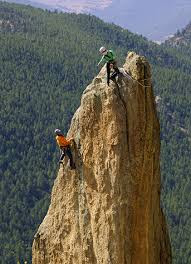
A more apt image for seeking truth would be--if truth is at the top of Mt. Everest
or some other peak of incredible height,
would you make the arduous climb, no matter what, and accept what is true?


Yes.

However, my main question isn't whether God exists or not. I worked through that at university to a very deep level and came out a committed theist (though on Thursday, I am still an existentialist;-).

What concerns me much more is the second part of Metha and McGrath's question:

What is God/Truth/Ultimate Reality like?

Can we finite reasoning primates even have any accurate idea?


In the Light,

Daniel Wilcox