Showing posts with label myth. Show all posts

Tuesday, May 14, 2019

FINDING WHAT IS TRUE

“Am I committed to any ‘truth’ so deeply that I am willing to die for it, and willing to live moment-by-moment,
hour-by-hour, year-by-year for that truth, until my death?

How does one find what is the Good, the True, the Just, the Beautiful?

How does any individual discover whether a philosophical, moral, or political claim is genuine, is true,
is ‘truth,’
is an accurate reality
NOT
misinformation,
confirmation bias,
social distortion,
myth,
cultural dysfunction,
mass delusion, or
intentional deception?

At 72 years of age, now, I look back…

Tuesday, July 3, 2018

Look at Facts versus Truth, AGAIN


From an Introduction to Literature book [with my own responding commentary and reflections in brackets]:
"Water boils at 212° F." True or false? It depends. In Denver, a mile high, the statement is false; at sea level, it is true, provided we all agree what F stands for, what the superscript means, and what the rest of the words in the statement denote.

“But facts - a kind of truth-are slippery. The fact that water flows downhill can be verified to most people's satisfaction by pouring water down a number of hills, but what practical test is there to verify that the square root of nine is three?
--

[Or that induction is to be trusted?
The philosopher David Hume stated that there is no proof for induction.

Or perception is real?

Or that all of existence is real, not illusion as Asian religions and some philosophers claim?]
--

“All this is by way of suggesting that fact and truth are not always identical. Nor should we assume that the only kind of truth we can rely on is the truth embodied in cold, hard fact. Consider the following for a moment.

“It is a truth about human life -has been and no doubt always will be - that a young man [or young woman] of great gifts must sooner or later make a choice, and in doing so he [she] closes the door on alternative choices.

“He may devote all his talent to becoming, say, a great soldier, and with diligence he may enjoy success. Or he may devote his talent to becoming a politician, and assuming he is willing to make the necessary sacrifices of time and energy, he may very well succeed there.

“Or he may concentrate all his gifts on becoming a playboy and bon vivant, and no doubt he will have success there too, always of course at the cost of realizing his potential in other areas of endeavor. Most of us can do only so much in one lifetime, and to do anything extremely well takes something close to total commitment.

“Insight into this truth is expressed in one of the great myths of classical antiquity. At a feast of the gods on Mount Olympus, the uninvited goddess of discord, Eris, mischievously threw onto the table an apple labeled "For the Fairest."

“Three feminine hands reached for it...To decide, the handsomest of mortals, Paris, was brought to the feast, where each of the three goddesses promised rewards to him if he would give the apple to her.

“...Paris...gave the apple to Aphrodite, and from that choice reaped the reward of Helen, most beautiful of women, with all the consequences-including the fall of Troy and the destruction of his family...

“Whether or not there was ever a man named Paris, there is truth in the myth that is as valid as fact, and more affecting.

“Myth, then, collects the diverse experience of the race of man and fashions it into memorable and enduring form.
--

[But is the literature textbook correct, that non-factual stories are as valid as facts?

Since the term, myth, has come to almost always mean falsehood, delusion, etc., a better word would be “life-stance story.” In such stories, there may be ethical truth, philosophical observation, even a lucid understanding of one aspect of Life or the Cosmos.

BUT on the other hand, there may be only illusion and dysfunction.

Consider for instance President Abraham Lincoln’s belief in fate—he was raised Calvinist but rejected the Christian religion yet kept its fixated belief in determinism!

Because of his deep sense of fate, and his belief in the belief of an inseparable Union, Lincoln caused the death of almost 1 million humans, untold wounding of millions more, the destruction of cities and farms, and an ambivalent legacy that is still with us, etc.]
--

“...Is it not true that men often do evil with the best of intentions?”
--

[For Lincoln’s nemesis—strangely the very military leader who before Lincoln’s war attack into the Confederacy, he had asked to lead all Union troops!--
Robert E. Lee, also, had life-changing beliefs, a strong Christian belief in predestination (not significantly different from Lincoln’s belief in fate), but which led to a completely opposite response in life—which also was involved in causing much of the death and destruction that President Lincoln instituted.

Strangely, Lee as a dedicated Christian said that we ought to love our enemies, but that didn't stop him from causing the death of hundreds of thousands of humans, some of whom he used to work with! Lee killed them in duty, honor, and justice:-(

Indeed, most of the 20th century, and now the 21st century has seen political and religious leaders, with the “best of intentions”
cause more untold evil—the slaughter of millions of civilians, hundreds of millions of humans--beginning with the Great War down to the current slaughters in the Middle East and invasion by the United States who currently fights in at least 7 separate wars among the many on-going Islamic fratricides.]
--

Or consider the famous life-stance story of Jews, Christians, and Muslims:
“the Garden of Eden and the events we are told took place there...

“Some people read the account in Genesis as factual truth, but it is hardly necessary to insist on literal accuracy to appreciate the profound…truths of the story told simply in Genesis…

“The temptation to rise above one's place in the universe…is a universal human experience...their effort to convince themselves that what they have done is right despite all evidence to the contrary. We can recognize these and other truths in the story, although we have never known a world literally like that of Adam and Eve.

“Perhaps the most profound aspect of the story lies in God's commandment that man not eat the fruit of the tree of knowledge and man's breaking of that commandment. We assume the value of knowledge, but many of the most able observers of man's progress wonder, as they ponder the future, whether what lies before us is ultimately good or evil.”
--

[The famous psychologist and professor Steven Pinker has written 2 lucid, heavily fact-based books, Better Angels of Our Nature and Enlightenment Now, showing that despite nearly constant gloomy media news, tremendous moral and flourishing life progress has actually been made by humans in the last 50 years.]
--

Contrarily,
“Has our knowledge outgrown our ability to use it wisely? As we learn how to destroy the inhabitants of the earth, and as we hover on the brink of discovering how to create life itself, we might find more significance in the ancient story of the fall of man than we had realized.”
--

[Many nations, currently, are turning to ‘strongmen’ to lead their nations. The U.S.—which already has many thousands of nuclear bombs, enough to destroy the world many times—is committed to building new ones and the current president, too, now wants to militarize Space!

Plus, President Trump has taken thousands of children away from refugee parents and claims that Americans ought to be “first” yet at the same time is strongly supported by over 81% of conservative Christians who claim he is “pro-life"!]
--

"I only have time for facts," the innocent often say. "No time for make-believe." But fiction-the best of it-isn't make-believe.

It is often the more enduring reality, and because it contains truth, it goes beyond personal and national boundaries. Thus, one need not be a Greek to recognize truth in Oedipus the King, or a Roman Catholic to be astonished by the accuracy of vision in The Divine Comedy.

“Nor does one have to insist on a literal interpretation of Christian doctrine in order to find profound truths about man and his fate in, Paradise Lost.

“1. Although facts are not the only form of truth, they are extremely important.

What is a fact?

What is the importance of facts in your everyday life?

What is the relationship between facts and ideas?

Between facts and opinions?

"2. Is man essentially good?

“Or is he essentially evil?
--from a literature textbook
--

[OR is the human primate not capable of good or evil?

IS the human species ONLY--
“You, your joys and your sorrow, your memories and your ambitions, your sense of personal identity and free will, are in fact no more than the behavior of a vast assembly of nerve cells and their associated molecules.”
-Francis Crick, the famous Scientist and Atheistic Naturalist

OR HOW can any of the life-stance stories possibly be true in the sense that the literary author means (ethically and philosophically, not factually)
since so many contradict each other.

To be continued—


In the Light,

Daniel Eugene Wilcox

Tuesday, January 16, 2018

How Do We Discern the True Nature of Reality--the LIGHT, from what's false: myth, illusion, and superstition?


As I still seek to advance more toward the Light,
despite my own aged physical receding,
(soon to be deader than a doorstopper), how do I and billions of other human
primates deal with the mysterious, conundrumed central questions of our existence?

1. What new ethical insights ought we to be seeking, and hopefully, finding, like our forebears
before us who discovered the truths of equality, human rights, peacemaking, and transcendence?

2. How do we counter the current false human narratives, life-stances, and worldviews which cause so much havoc, intolerance, anguish, suffering,
and destruction?

3. How do we discern what is true versus what is illusion and superstition in ultimate matters, when we can't prove "OUGHTs"?

For instance, how can we witness to human worth?

Hard secularists claim there is so much evidence from biology, neuroscience, and physics that
human choice,
moral responsibility,
creativity,
even human consciousness are ALL illusions/delusions.

According to them only atoms locked-into-a-hard-fated cosmos exist. NOTHING else.


4. If every human truly has inherent value, why is it that so many billions of humans deny this in their reasoning, or their daily behavior?

5. How are Friends (and other transcendentalists and moral realists) different from humanists who appear to claim that all humans do have "inherent worth" YET at the same time claim that only matter and energy exist?

Human Manifesto III: "We are committed to treating each person as having inherent worth and dignity, and to making informed choices in a context of freedom consonant with responsibility."

Is this a semantic problem or are they being contradictory?

6. Do we ourselves have contradictions within our own life-stance?

7. This day are we moment by moment working in each relationship to truly relate as that the other person has "inherent value' within her/himself?


In the Light,

Daniel Wilcox


Friday, November 17, 2017

Light and Rearranging Chairs in the Midst of Multiple Hurricanes


Again, and again...rearranging deck chairs in the midst of multiple hurricanes...
one discouraging image that comes to mind when reflecting-ruminating-contemplating
on the recent breakups of two more Friends Yearly Meetings (NCYM and NWYM)
while the world suffers endless severe crises,
millions are destitute,
many persecuted, abused, and slaughtered.

And on the current absurd political wranglings--leftovers and rightwrongs...

Been there:

Was a member and leader in California Yearly Meeting shortly before it broke from Friends United Meeting, back when the Yearly Meeting opposed freezing nuclear weapons. In fact, many members defended nuclear weapons, though their Faith and Practice clearly condemned ALL war.

Instead most time was focused on lesser doctrinal points and the danger of possible uncontrolled behavior during open worship...

Attended a local Arizona meeting of Intermountain Yearly Meeting with my wife, where to our bafflement and shock, some Friends followed forms closely, yet defended killing...

Was a member of Pacific Yearly Meeting where some members opposed support and involvement in peacemaking in Iraq because the word "Christian" was part of the name, even though Friend Tom Fox, as a member of Christian Peacemaker Teams, had already been died witnessing for and working for peace in Iraq.

Instead, we spent considerable time on plans to get a peace pole erected....:-(

And worse...

Since I'm an extremely liberal Friend far out on the edge and have plenty of my own shortcomings and failures,
no doubt, other Friends could point out many ways that I, too, don't live up to the Light.

STILL.

Think about this: What is the Friends/Quakers beyond an empty form?

Even back in the 19th century, social activist Friends were opposed by their meetings because of their abolition work.
Most Friends instead focused on their religious forms.

Modern Friends insert totally contrary, contradictory views,
advocate opposing ethics,
even deny that the Light exists,
or insist that only a doctrinaire understanding of God is the Light.

At times, as a UU-leaning Friend, I'm tempted to jump ship.


Only the Unitarian-Universalists are also rearranging chairs, still order their services like traditional churches! And are caught down in a severe controversy right now, too (including opposition to their UU president).

And, strangely, like some Friends, many UU's claim the lifestance of Pagan!

Huh? How could any rational, contemplative members of Quakers and UU ever think that the cosmos is polytheistic?

Furthermore, such a worldview--Paganism--is completely contrary to everything that is essential to being a Friend (and a UU).

If you think differently, please comment on why you believe my observation is incorrect.

What if instead of inserting almost any and all contrary ethics and philosophies into the empty-bucket called Quakers...

What if instead of acting like lawyers arguing over minutia and forms...


What if all of us, instead, centered,
then
stood up against all war, inequality, injustice
and focused on seeking
the True, the Good, the Just, the Beautiful?


In the Light,

Daniel Wilcox

Monday, September 5, 2016

Evaluating Morality without Religion


But look at how strange the list is considering that it was posted by nontheists this week on the Internet.

Many theists agree with all of these points, especially Friendly-oriented ones. Indeed, most of these points are why they are theists!

Quakers live in the Light with a very similar list.

#1 REASON, not superstition:
Great theistic scientists such Arthur Eddington, English astronomer, astrophysicist, philosopher, and mathematician would very strongly agree and support this phrase brainer!

For REASON is the CenterPoint of the Enlightenment and is the basis of science.

I strongly agree, am reason-centered, and hate superstition in all its forms.

If so many theists support "REASON, not superstition," what does this then have to do with atheism?!

The view that reason is reliable, that it qualifies as the best way for all humans to function would seem to show that it aligns with reality.

Thus it is probably inherent in reality, as much as math. It isn't a human construct, isn't an accident, and isn't a subjective cultural standard.

If so, that is a deep theistic outlook, not an atheistic one.

After all, reason was a center-post of great leaders such as Voltaire, Thomas Paine, Thomas Jefferson, Benjamin Franklin, etc.

All of them were committed to belief and trust in the God of reason, that reason is the way for humans to make decisions and to probe life, the cosmos, and all of reality.

As the Enlightenment's declarations emphasized, they based their views of justice, human rights, and truth on reality's God.


Arthur Eddington put it this way:
“The mind-stuff of the world is, of course, something more general than our individual conscious minds.... The mind-stuff is not spread in space and time; these are part of the cyclic scheme ultimately derived out of it.... It is necessary to keep reminding ourselves that all knowledge of our environment from which the world of physics is constructed, has entered in the form of messages transmitted along the nerves to the seat of consciousness...."

"Consciousness is not sharply defined, but fades into subconsciousness; and beyond that we must postulate something indefinite but yet continuous with our mental nature.... It is difficult for the matter-of-fact physicist to accept the view that the substratum of everything is of mental character. But no one can deny that mind is the first and most direct thing in our experience, and all else is remote inference."
— Eddington, The Nature of the Physical World, 276-81.

#2 ETHICS, not dogma:
The beginning of the Friends was ethically directed, not dogmatic or doctrinal; in fact the leaders strongly opposed religious dogma.

When Friends encountered injustice, immoral actions, and abuse, many of them stood up against such unethical behavior, no matter how much the perpetrators of the actions justified by them by religious or atheistic dogma.

And millions of ethical social activists of other worldviews have done so as well.

#3 RESPECT, not worship:
This is a more difficult statement to deal with because of the semantic problems. Friends and many other searchers for truth, justice, human rights, equality, reconciliation, peace would support the importance of RESPECT.

But here’s the conundrum: Quakers and many other theists base their support for respect in WORSHIP!

What so many of us mean by the term, “worship,” is probably--most likely--NOT
what the secularist meant by the term.

According to the Merriam-Webster Dictionary, worship means:
"the act of showing respect and love..."


Friends mean communion,
communication,
wonder,
transcendence,
spiritual intimacy...


The original writer of "...not worship" wasn't opposing "the act of showing respect and love...," nor was he against communication, intimacy, or wonder.

Rather, based on #1's statement, it seems likely that he does show a lot of respect, even love, for REASON and other important humanistic values.

It's the second part and secondary definitions of "worship" that secularists reject--
that of "...for a god, especially by praying with other people who believe in the same god... reverence offered a divine being or supernatural power.."
and
"...a form of religious practice with its creed and ritual."

Yes, nontheists think “worship” is a very negative term meaning:
delusion,
harmful, mean servile scraping,
and terrified fear of the dogmatic god of hellfire who is obsessed with his own glory.

Their rejection of "worship," is the rejection of doctrinal, creedal Christian, Muslim, and Hindu dogma; rejection of the Augustinian/Reformed/Sunni/Shia/Hindu God who is fixated on his own self.

They reject the divinity that, to quote Mahatma Gandhi, treats humans as “toys.” The same god who considers humankind as worthless, that every human infant is "in essence, evil" at conception, etc.

If that is the definition of “worship,” then we certainly are opposed to worship, too.

So were Enlightenment figures including Thomas Jefferson.


Maybe, we ought to abandon the word itself, because like other overused empty-bucket words--
ones which are used, abused, and misunderstood such as god, good, love, etc.—-
“worship” confuses rather than enlightens.


#4 COURAGE, not fear:
This would seem to be a universal agreed upon virtue by nearly all humans, though acting in courage, not fear, is entirely more difficult than supporting the action.

#5 FACT, not myth:
Again, this is another case of slimy semantics;-) Most people would agree if one means the common everyday definitions.

But again, applying this is more difficult for most people than one would ever imagine. Just look at the current presidential candidate campaign where most Americans are majoring in “myths,” advocating all sorts of ad hominem, distortions, plain propaganda, slander, and demeaning, untrue stories.

Much of the media is full of some of the most ridiculously superstitious, irrational, and unfactual information. And these "myth" spews come from many secular as well as religious leaders.

#6 MORALITY, not religion.
Ditto for what I explained in the numbers above.

It is very important to emphasize this separation, this rejection. Nearly always in the past, and everywhere now, religion is the source, cause, and inflictor of countless immoral attitudes, outlooks, laws, rituals, behaviors, and actions.

The most baffling aspect of this statement though is that many of the nontheists who claim to support “morality” actually think that no real ethics exist, that ethics are whatever humans choose them to be.

For instance, one nontheist leader stated, "There are no universal moral values."

Another, there is "no moral responsibility" not even for murdering and raping!

Instead, what many secularists mean by the term “morality” is only
“subjective preference,”
“like/dislike,”
“social construct,”
"cultural standards,"
and so forth.

They claim being opposed to slavery or rape or dishonesty, etc. is only similar to disliking a color such as blue or disliking chocolate!


According to them, morality is only an "opinion."

Other nontheists state that morality is a purposeless adaption of evolution, a survival mechanism.

From an interview with the brilliant biologist Richard Dawkins:

RD: My value judgment itself could come from my evolutionary past.

JB: So therefore it’s just as random in a sense as any product of evolution.

RD: You could say that, it doesn’t in any case, nothing about it makes it more probable that there is anything supernatural.

JB: Ultimately, your belief that rape is wrong is as arbitrary as the fact that we’ve evolved five fingers rather than six.

RD: You could say that, yeah.
--

Philosopher of Science professor Michael Ruse, makes similar statements:

“Morality is a biological adaptation, no less than are hands and feet and teeth … Morality is just an aid to survival and reproduction.”
-
American historian of science William Provine, professor of the history of science at Cornell University:

“Let me summarize my views on what modern evolutionary biology tells us, loud and clear, and I must say that these are basically Darwin’s views: there are...no purposive forces of any kind...
no ultimate foundation for ethics,
no ultimate meaning in life,
and no free will for humans either..."
--

Evolutionist Craig Palmer:
"That there is obviously some evolutionary basis to rape just like there is some evolutionary basis to all aspects of living things.

In the book we narrow it down to two plausible specific evolutionary reasons for why we are a species in which rape occurs. One is just a by-product of evolved differences between the sexualities of males and females.

Or, two, rape might be an adaptation. There might have been selection favouring males who raped under some circumstances in the past. And therefore there might be some aspects of male brains designed specifically to rape under some conditions.

An evolutionary reason is also known as the ultimate level of explanation. It’s really the question of why are we the way we are?
And the evolutionary answer is what selective forces favoured those traits in hundreds or thousands of past generations that we eventually end up with today.
A Natural History Of Rape: Biological Bases Of Sexual Coercion by Craig Palmer and Randy Thornhill, MIT Press
--

Thankfully, Palmer disagrees with evolution's adaption and states that he is strongly opposed to rape, that such a human action is immoral, but he does think that raping is a result of natural selection.

Thus it is uncertain and confusing how so very many secularists yet claim that human ethics result from evolution.

If both raping versus non-raping, slavery versus abolition, and all other actions of humans are ONLY the result of natural selection, how can anyone think that morality exists (except as one adaption of evolution)?

How could we humans come to an understanding as to which evolutionary adaptions are better than the other contrary ones?

Lastly, on a related topic, it would appear that when Palmer says "there is some evolutionary basis to all aspects of living things" he also means that the human fixation for "religion" is a result of natural selection, too!


#7 CLARITY, not delusion:
See above.

#8 GOOD, not god:
What?! How can there possibly be any good without god?

Again, everyone needs to define the terms. If one means the god of religion, then, for sure, good can exist without god.

Indeed, religion often opposes the good as in the case of Segregation in the United States and in the case of Apartheid in South Africa. And, currently, in the U.S. and many other countries throughout the world, religion supports inequality, injustice, and sexism.

One of the center-points of the Enlightenment is that religion opposes the GOOD.


But if one means by “not god” that reality—all of existence is completely meaningless, purposeless, then “good” in the sense of objective, true, and real can’t exist.

If there is no objective, true, and real “good,” then how could we humans do “good”?

That would be like saying there is NO COLOR, but please paint a drawing in red, since it is the best color!

Huh?

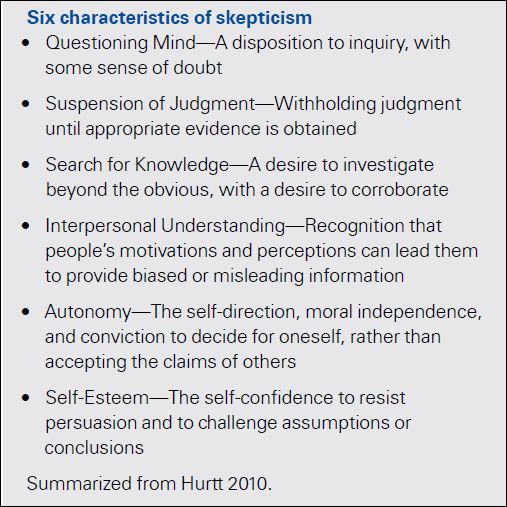
#9 SKEPTICISM, not cynicism:
This is an extremely important value to hold. Merriam-Webster Dictionary--skeptic: “a person who questions or doubts…”

Such an attitude/behavior is the very first step to learning.

Without questioning, no learning is possible, only memorization and brain-washing.


And, who, except very negative, dysfunctional, or even nihilistic individuals wants to be a cynic?

Yes, I know there are actually a number of famous cynics,
but cynicism doesn’t bring hope,
doesn't rescue those who are suffering,
doesn't seek to free prisoners of conscience...

M-W-D- cynic: “a person who has negative opinions about other people...especially a person who believes that people are selfish, a faultfinding captious critic.

#10 RATIONALITY, not ideology:
Many a hand-clap to that:-) So many humans, even ones who manage to understand and reject superstition, religion, and illusion often yet get caught in the wiles of ideologies.

History is strewn with millions of corpses and devastated landscapes which show that this is all too true.

Every individual first needs to use his/her reason within to live rationally before trying to fix the mental attitudes/structures, behaviors, and wrong actions of others.

GREAT TO-DO LIST for humanity, for all of us humans!

I would add a few more essentials such as:

#11 EQUALITY, not sexism, racism, nationalism

#12 COMPASSION, not survival, natural selection,

#13 INCLUSION, not anti-immigration, prejudice,

#14: NONVIOLENT PEACEMAKING, not war,

#15 NO-HARM FOOD, not meat-eating,

#16 WONDER, not materialism

#17 HOPE, not negativity


In every moment, choose to live closer to these essential center-points.

In the Light,

Daniel Wilcox