Here's a Christmas quilt to bring beauty, joy, merriness, worship, and thankfulness this Christmas.
It was created by my sweetheart, Betsy. She calls it Christmas Sparkle.
(I've added, Christmas Sparkling Vividly.)
Musings on Ultimate Reality, ethics, religion, social history, literature, media, and art
Showing posts with label worship. Show all posts
Saturday, December 20, 2025
Beauty of Quilting at Christmas
Labels:
artistic,
beauty,
Christmas,
creativity,
Friends,
fun,
joy,
merriness,
Quaker,
quilt,
sparkle,
thankfulness,
transcendent,
worship
Saturday, July 29, 2023
Why Be a Quaker? Transcendent open worship--a powerful example from Pacific Yearly Meeting
Our worldwide Society of Friends has seriously splintered in the last 150 years into very different camps, most of whom have very little in common with the early founders of the spiritual movement. Quite a few of us have often pondered over this severe quandary.* Many books and conferences over the years have struggled...
Instead of dwelling in that past, let us be Present now. Here is an actual Transcendent experience of the Light at a Pacific Yearly Meeting for worship in California.
OPEN WORSHIP TRANSCENDS
Drowned in family tragedy, despairing, distraught--
that morning earlier;
thus, down encumbered,
he came to worship meeting, but not speaking
of his family’s severe circumstance, kept hidden;
But in the midst
of open expectant communion, Transcendent Light
shown forth in a stranger’s sudden
a cappella spiritual chorus--
a deep songing deepening within;
intense meaning lifted us gathered in communion--
vivid encouraging Hope;
That sacred chorus didn’t take away our shattered glass
lives, nor end many distraught
circumstances and tragedies--
but
Oh, what Hope fulled within.
In the LIGHT,
Dan Wilcox
In a later article, I could give my own understanding
of some of the complex series of tragic evidences of how it came that the Society kept breaking into contrary groups...
or of the equally troubling 'quietistic' era before that when there were many rigid religious restrictions on Quakers, including that no Quaker could marry a non-Quaker and remain in good standing.
We are in this sometimes disagreeable patchwork/collage called Friends, Quakerism, and
on why to continue to move toward the Light within this small 380-year-old movement.
1. For me personally, I visited a Friends meeting one Sunday and was drawn to its less-ritual, more open experiential worship.
Side Note: Besides the experiential factor that I came to Quakerism because I was a conscientious objector to the VietNam War serving my drafted time working in a mental hospital.
This was with other pacfists in the Fall of 1967 near Philadelphia, PA. I was helping pay the rent for a one-bedroom apartment in Trevose, PA. 3 Mennonite/Brethren C.O.'s slept in the bedroom on cots, me on a mat behind the couch in the living room:-).
I greatly valued creativity, openness, experiential spirituality, so one can see why the Society of Friends meeting was a wonderful new experience.
Before being drafted, I had been a Creative Writing major at Long Beach State in California. Now in September 1967, I was newly arrived in Pennsylvania near Washington's Crossing, and wanted to find a new church.
I had admired the Quakers in the news 6 years before back in 1961 for protesting against nuclear weapons, so I decided to give their meeting a visit.
After one Sunday going to a nearly empty meeting for worship near Newtown in September, I eventually began regularly attending worship in downtown Philly at Backbench Young Adult Friends gathering. Though as a mental health worker, I worked 10 days on, 4 days off so could only take the L-Train into downtown Philly 2 times a month.
How powerful those times of OPEN WORSHIP were!
I’m not into forms, not sharply, rigidly, traditionally, ritually-structured forms. As all artists and writers know, “form and freedom” are 2 contrary characteristics of any creative endeavor.
One needs both freedom and form. Not either or. Too much freedom, chaos and havoc and destruction rule, too much form, slavery and rigidity and still-death reign.
Quaker meeting for worship seemed the perfect combination of freedom and form!
2. While actual spiritual experiences--vivid stories that happen to us humans don't prove our views are correct, there is GREAT inherent worth in such transcendent experiences,
as shown with the poetic sharing of the Light-filled worship one First Day at Pacific Yearly Meeting in California.
Instead of dwelling in that past, let us be Present now. Here is an actual Transcendent experience of the Light at a Pacific Yearly Meeting for worship in California.
OPEN WORSHIP TRANSCENDS
Drowned in family tragedy, despairing, distraught--
that morning earlier;
thus, down encumbered,
he came to worship meeting, but not speaking
of his family’s severe circumstance, kept hidden;
But in the midst
of open expectant communion, Transcendent Light
shown forth in a stranger’s sudden
a cappella spiritual chorus--
a deep songing deepening within;
intense meaning lifted us gathered in communion--
vivid encouraging Hope;
That sacred chorus didn’t take away our shattered glass
lives, nor end many distraught
circumstances and tragedies--
but
Oh, what Hope fulled within.
In the LIGHT,
Dan Wilcox
In a later article, I could give my own understanding
of some of the complex series of tragic evidences of how it came that the Society kept breaking into contrary groups...
or of the equally troubling 'quietistic' era before that when there were many rigid religious restrictions on Quakers, including that no Quaker could marry a non-Quaker and remain in good standing.
We are in this sometimes disagreeable patchwork/collage called Friends, Quakerism, and
on why to continue to move toward the Light within this small 380-year-old movement.
1. For me personally, I visited a Friends meeting one Sunday and was drawn to its less-ritual, more open experiential worship.
Side Note: Besides the experiential factor that I came to Quakerism because I was a conscientious objector to the VietNam War serving my drafted time working in a mental hospital.
This was with other pacfists in the Fall of 1967 near Philadelphia, PA. I was helping pay the rent for a one-bedroom apartment in Trevose, PA. 3 Mennonite/Brethren C.O.'s slept in the bedroom on cots, me on a mat behind the couch in the living room:-).
I greatly valued creativity, openness, experiential spirituality, so one can see why the Society of Friends meeting was a wonderful new experience.
Before being drafted, I had been a Creative Writing major at Long Beach State in California. Now in September 1967, I was newly arrived in Pennsylvania near Washington's Crossing, and wanted to find a new church.
I had admired the Quakers in the news 6 years before back in 1961 for protesting against nuclear weapons, so I decided to give their meeting a visit.
After one Sunday going to a nearly empty meeting for worship near Newtown in September, I eventually began regularly attending worship in downtown Philly at Backbench Young Adult Friends gathering. Though as a mental health worker, I worked 10 days on, 4 days off so could only take the L-Train into downtown Philly 2 times a month.
How powerful those times of OPEN WORSHIP were!
I’m not into forms, not sharply, rigidly, traditionally, ritually-structured forms. As all artists and writers know, “form and freedom” are 2 contrary characteristics of any creative endeavor.
One needs both freedom and form. Not either or. Too much freedom, chaos and havoc and destruction rule, too much form, slavery and rigidity and still-death reign.
Quaker meeting for worship seemed the perfect combination of freedom and form!
2. While actual spiritual experiences--vivid stories that happen to us humans don't prove our views are correct, there is GREAT inherent worth in such transcendent experiences,
as shown with the poetic sharing of the Light-filled worship one First Day at Pacific Yearly Meeting in California.
Saturday, November 23, 2019
Part 4: Commune in Awe in the Light, rather than "worship" since that has become an ambiguous term
Part 4: Realistic Hope
1.Begin with Reason
2.Humbly Seek and Search
3.Base Your Actions on Moral Realism
4.Don't Start with Ancient Scriptures
5.Study Cosmology, Astronomy, and Other Sciences
6.Be Open to Discovery, but Cautious of Speculative Claims
7.Keep an Informed Mind and Hopeful Outlook
8.Avoid Confirmation Bias, In-Group Dynamics,
Ideological Claims,Reductionism,
Fallacies,and 'Anecdotal Evidence.'
9.Speak Truth to Power; Work for Peace and Justice
10.Commune with Others in Awe in the Light
Live Oak Meeting House
Labels:
awe,
commune,
equality,
Friends,
inherent,
inner,
Light,
meeting house,
moral realism,
outer,
Quaker,
sanctuary,
share,
silence,
speaking truth to power,
transcendent,
vigil,
Wonder,
worship
Monday, September 5, 2016
Evaluating Morality without Religion
But look at how strange the list is considering that it was posted by nontheists this week on the Internet.
Many theists agree with all of these points, especially Friendly-oriented ones. Indeed, most of these points are why they are theists!
Quakers live in the Light with a very similar list.
#1 REASON, not superstition:
Great theistic scientists such Arthur Eddington, English astronomer, astrophysicist, philosopher, and mathematician would very strongly agree and support this phrase brainer!
For REASON is the CenterPoint of the Enlightenment and is the basis of science.
I strongly agree, am reason-centered, and hate superstition in all its forms.
If so many theists support "REASON, not superstition," what does this then have to do with atheism?!
The view that reason is reliable, that it qualifies as the best way for all humans to function would seem to show that it aligns with reality.
Thus it is probably inherent in reality, as much as math. It isn't a human construct, isn't an accident, and isn't a subjective cultural standard.
If so, that is a deep theistic outlook, not an atheistic one.
After all, reason was a center-post of great leaders such as Voltaire, Thomas Paine, Thomas Jefferson, Benjamin Franklin, etc.
All of them were committed to belief and trust in the God of reason, that reason is the way for humans to make decisions and to probe life, the cosmos, and all of reality.
As the Enlightenment's declarations emphasized, they based their views of justice, human rights, and truth on reality's God.
Arthur Eddington put it this way:
“The mind-stuff of the world is, of course, something more general than our individual conscious minds.... The mind-stuff is not spread in space and time; these are part of the cyclic scheme ultimately derived out of it.... It is necessary to keep reminding ourselves that all knowledge of our environment from which the world of physics is constructed, has entered in the form of messages transmitted along the nerves to the seat of consciousness...."
"Consciousness is not sharply defined, but fades into subconsciousness; and beyond that we must postulate something indefinite but yet continuous with our mental nature.... It is difficult for the matter-of-fact physicist to accept the view that the substratum of everything is of mental character. But no one can deny that mind is the first and most direct thing in our experience, and all else is remote inference."
— Eddington, The Nature of the Physical World, 276-81.
#2 ETHICS, not dogma:
The beginning of the Friends was ethically directed, not dogmatic or doctrinal; in fact the leaders strongly opposed religious dogma.
When Friends encountered injustice, immoral actions, and abuse, many of them stood up against such unethical behavior, no matter how much the perpetrators of the actions justified by them by religious or atheistic dogma.
And millions of ethical social activists of other worldviews have done so as well.
#3 RESPECT, not worship:
This is a more difficult statement to deal with because of the semantic problems. Friends and many other searchers for truth, justice, human rights, equality, reconciliation, peace would support the importance of RESPECT.
But here’s the conundrum: Quakers and many other theists base their support for respect in WORSHIP!
What so many of us mean by the term, “worship,” is probably--most likely--NOT
what the secularist meant by the term.
According to the Merriam-Webster Dictionary, worship means:
"the act of showing respect and love..."
Friends mean communion,
communication,
wonder,
transcendence,
spiritual intimacy...
The original writer of "...not worship" wasn't opposing "the act of showing respect and love...," nor was he against communication, intimacy, or wonder.
Rather, based on #1's statement, it seems likely that he does show a lot of respect, even love, for REASON and other important humanistic values.
It's the second part and secondary definitions of "worship" that secularists reject--
that of "...for a god, especially by praying with other people who believe in the same god... reverence offered a divine being or supernatural power.."
and
"...a form of religious practice with its creed and ritual."
Yes, nontheists think “worship” is a very negative term meaning:
delusion,
harmful, mean servile scraping,
and terrified fear of the dogmatic god of hellfire who is obsessed with his own glory.
Their rejection of "worship," is the rejection of doctrinal, creedal Christian, Muslim, and Hindu dogma; rejection of the Augustinian/Reformed/Sunni/Shia/Hindu God who is fixated on his own self.
They reject the divinity that, to quote Mahatma Gandhi, treats humans as “toys.” The same god who considers humankind as worthless, that every human infant is "in essence, evil" at conception, etc.
If that is the definition of “worship,” then we certainly are opposed to worship, too.
So were Enlightenment figures including Thomas Jefferson.
Maybe, we ought to abandon the word itself, because like other overused empty-bucket words--
ones which are used, abused, and misunderstood such as god, good, love, etc.—-
“worship” confuses rather than enlightens.
#4 COURAGE, not fear:
This would seem to be a universal agreed upon virtue by nearly all humans, though acting in courage, not fear, is entirely more difficult than supporting the action.
#5 FACT, not myth:
Again, this is another case of slimy semantics;-) Most people would agree if one means the common everyday definitions.
But again, applying this is more difficult for most people than one would ever imagine. Just look at the current presidential candidate campaign where most Americans are majoring in “myths,” advocating all sorts of ad hominem, distortions, plain propaganda, slander, and demeaning, untrue stories.
Much of the media is full of some of the most ridiculously superstitious, irrational, and unfactual information. And these "myth" spews come from many secular as well as religious leaders.
#6 MORALITY, not religion.
Ditto for what I explained in the numbers above.
It is very important to emphasize this separation, this rejection. Nearly always in the past, and everywhere now, religion is the source, cause, and inflictor of countless immoral attitudes, outlooks, laws, rituals, behaviors, and actions.
The most baffling aspect of this statement though is that many of the nontheists who claim to support “morality” actually think that no real ethics exist, that ethics are whatever humans choose them to be.
For instance, one nontheist leader stated, "There are no universal moral values."
Another, there is "no moral responsibility" not even for murdering and raping!
Instead, what many secularists mean by the term “morality” is only
“subjective preference,”
“like/dislike,”
“social construct,”
"cultural standards,"
and so forth.
They claim being opposed to slavery or rape or dishonesty, etc. is only similar to disliking a color such as blue or disliking chocolate!
According to them, morality is only an "opinion."
Other nontheists state that morality is a purposeless adaption of evolution, a survival mechanism.
From an interview with the brilliant biologist Richard Dawkins:
RD: My value judgment itself could come from my evolutionary past.
JB: So therefore it’s just as random in a sense as any product of evolution.
RD: You could say that, it doesn’t in any case, nothing about it makes it more probable that there is anything supernatural.
JB: Ultimately, your belief that rape is wrong is as arbitrary as the fact that we’ve evolved five fingers rather than six.
RD: You could say that, yeah.
--
Philosopher of Science professor Michael Ruse, makes similar statements:
“Morality is a biological adaptation, no less than are hands and feet and teeth … Morality is just an aid to survival and reproduction.”
-
American historian of science William Provine, professor of the history of science at Cornell University:
“Let me summarize my views on what modern evolutionary biology tells us, loud and clear, and I must say that these are basically Darwin’s views: there are...no purposive forces of any kind...
no ultimate foundation for ethics,
no ultimate meaning in life,
and no free will for humans either..."
--
Evolutionist Craig Palmer:
"That there is obviously some evolutionary basis to rape just like there is some evolutionary basis to all aspects of living things.
In the book we narrow it down to two plausible specific evolutionary reasons for why we are a species in which rape occurs. One is just a by-product of evolved differences between the sexualities of males and females.
Or, two, rape might be an adaptation. There might have been selection favouring males who raped under some circumstances in the past. And therefore there might be some aspects of male brains designed specifically to rape under some conditions.
An evolutionary reason is also known as the ultimate level of explanation. It’s really the question of why are we the way we are?
And the evolutionary answer is what selective forces favoured those traits in hundreds or thousands of past generations that we eventually end up with today.
A Natural History Of Rape: Biological Bases Of Sexual Coercion by Craig Palmer and Randy Thornhill, MIT Press
--
Thankfully, Palmer disagrees with evolution's adaption and states that he is strongly opposed to rape, that such a human action is immoral, but he does think that raping is a result of natural selection.
Thus it is uncertain and confusing how so very many secularists yet claim that human ethics result from evolution.
If both raping versus non-raping, slavery versus abolition, and all other actions of humans are ONLY the result of natural selection, how can anyone think that morality exists (except as one adaption of evolution)?
How could we humans come to an understanding as to which evolutionary adaptions are better than the other contrary ones?
Lastly, on a related topic, it would appear that when Palmer says "there is some evolutionary basis to all aspects of living things" he also means that the human fixation for "religion" is a result of natural selection, too!
#7 CLARITY, not delusion:
See above.
#8 GOOD, not god:
What?! How can there possibly be any good without god?
Again, everyone needs to define the terms. If one means the god of religion, then, for sure, good can exist without god.
Indeed, religion often opposes the good as in the case of Segregation in the United States and in the case of Apartheid in South Africa. And, currently, in the U.S. and many other countries throughout the world, religion supports inequality, injustice, and sexism.
One of the center-points of the Enlightenment is that religion opposes the GOOD.
But if one means by “not god” that reality—all of existence is completely meaningless, purposeless, then “good” in the sense of objective, true, and real can’t exist.
If there is no objective, true, and real “good,” then how could we humans do “good”?
That would be like saying there is NO COLOR, but please paint a drawing in red, since it is the best color!
Huh?
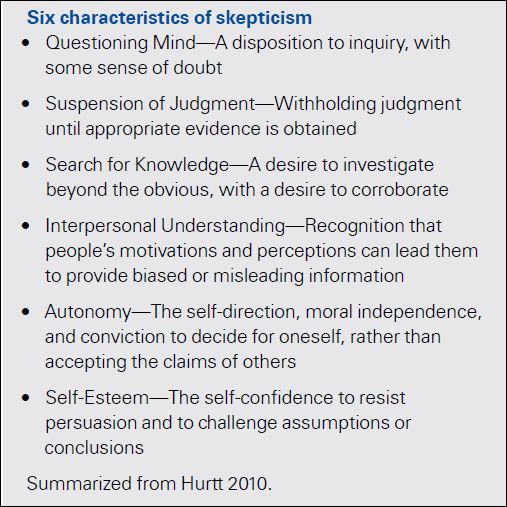
#9 SKEPTICISM, not cynicism:
This is an extremely important value to hold. Merriam-Webster Dictionary--skeptic: “a person who questions or doubts…”
Such an attitude/behavior is the very first step to learning.
Without questioning, no learning is possible, only memorization and brain-washing.
And, who, except very negative, dysfunctional, or even nihilistic individuals wants to be a cynic?
Yes, I know there are actually a number of famous cynics,
but cynicism doesn’t bring hope,
doesn't rescue those who are suffering,
doesn't seek to free prisoners of conscience...
M-W-D- cynic: “a person who has negative opinions about other people...especially a person who believes that people are selfish, a faultfinding captious critic.
#10 RATIONALITY, not ideology:
Many a hand-clap to that:-) So many humans, even ones who manage to understand and reject superstition, religion, and illusion often yet get caught in the wiles of ideologies.
History is strewn with millions of corpses and devastated landscapes which show that this is all too true.
Every individual first needs to use his/her reason within to live rationally before trying to fix the mental attitudes/structures, behaviors, and wrong actions of others.
GREAT TO-DO LIST for humanity, for all of us humans!
I would add a few more essentials such as:
#11 EQUALITY, not sexism, racism, nationalism
#12 COMPASSION, not survival, natural selection,
#13 INCLUSION, not anti-immigration, prejudice,
#14: NONVIOLENT PEACEMAKING, not war,
#15 NO-HARM FOOD, not meat-eating,
#16 WONDER, not materialism
#17 HOPE, not negativity
In every moment, choose to live closer to these essential center-points.
In the Light,
Daniel Wilcox
Labels:
Atheism,
dogma,
Ethics,
evolution,
God,
good,
morality,
myth,
natural selection,
Quaker,
rape,
rationalism,
Reason,
religion,
skeptic,
Slavery,
superstition,
Theism,
transcendence,
worship
Friday, November 21, 2014
The Far and the Near of Quakerism
“The Far and the Near” is a powerful short story by Thomas Wolfe, the lyrical American writer.
In the brief story, the narrator tells of how he often passes by a pleasing-looking house and family in the distance. That place and that family seem to epitomize all that is good and hopeful in the world.
Then, finally, one day the narrator decides to visit the far place. He drives to the distant location, with high hope and deep intensity, expecting to find this warm family and beautiful place, this shining star of joy always, only seen from afar.
But when he arrives, the observer is faced, instead with brute, ugly facts so unlike his hopeful expectations.
“Why had...the very entrance to this place he loved turned unfamiliar as the landscape of some ugly dream? Why did he now feel this sense of confusion, doubt and hopelessness?...with a sense of bitter loss and grief, he was sorry he had come...
All the brave freedom, the warmth and the affection had...vanished...But he faltered on, fighting stubbornly against the horror of regret, confusion, disbelief that surged up in his spirit, drowning all his former joy…”
--
When I was viewing and longing for the Society of Friends from afar, it looked like the true deal in a world awash with destructive and delusionary religion. It seemed an Ideal, Christianity truly lived—weekly real encounter with the Divine, communal communion living within worship and then active peacemaking, etc.
I would often drive long distances in order to participate in Quaker worship. And I did experience a deep sense of God’s presence sometimes, despite the usual quieting of my busy-body mind within.
But when I finally came near—actually lived near a Friends meeting and became an active member, and taught a Quaker class on Friends history and witness, I discovered a significant number of Quakers in the U.S. and England don't even think the Divine exists!
They are nontheists who go to weekly worship to not worship!
And, strangely, it turned out there are many Quakers who actively support war. What?!
California Yearly Meeting (of which my wife and I were devoted members) strongly refused to oppose nuclear weapons at its yearly conference!
Instead, members and leaders got up and defended not only regular war, but the possession and threat of atomic bombs!
I went home very troubled and disillusioned. How Far Quakerism in Southern California was from the Near of the Ideal.
There was an intentional willingness for killing in some “liberal” meetings, too!
Once I so wanted to be “near” that my wife and I drove over 2 hours to a liberal Friends meeting only to have members there speak up in the meeting in support of killing! Later, the AFSC in some cases even supported war.
My wife, who wasn't diligently a Friend but more a ride-along:-), wondered why we had bothered.
Then later after we joined a Friends Meeting, finally really got regularly “Near,” our local meeting hired an active fighter pilot as its leader…
Then it got even worse.
“Something is happening here, and we don’t know what it is, do we Mr. Fox?” (to misquote Dylan, Bob not Thomas).
Where was the beautiful spiritual home and family I had pined for so long?
Not that I wasn't also most of the problem...
But I was seeking help and spiritual communion for my own suffering life, not another secular gathering, that denied the Transcendent, or one which would be as gung-ho for war as most religions.
However, I said to myself--and many others--despite all these tragic developments, true Quakerism isn't like this.
What we need to do is get back to the real and true early movement of the Friends. That true Quakerism of Far in the past, the 1640’s.
But then I came face to face with textural evidence that early Quakers weren't like the Ideal either.
Oh, the far and the near...
For instance,
Quaker historian, David Boulton, proved my view of early Friends wrong.
Contrary to popular understanding, and Quaker histories, the original Friends weren't active peacemakers, actively opposed to war.
Boulton shows in “Militant Seedbeds of Early Quakerism" that, originally, Quakers strongly supported war, and war of the worst kind ("unkind").
George Fox even called on the Puritan warlord Oliver Cromwell to extend the English Civil War into continental Europe!
From “Militant Seedbeds of Early Quakerism:
“Consider this message to Cromwell, signed “George Fox” and dated January 1658, where the Protector is lambasted for not carrying his military conquests into Europe and on to Rome itself—even to the Turkish empire:
“Oliver, hadst thou been faithful and thundered down the deceit, the Hollander had been thy subject and tributary, Germany had given up to have done thy will, and the Spaniard had quivered like a dry leaf wanting the virtue of God, the King of France should have bowed his neck under thee,
the Pope should have withered as in winter,
the Turk in all his fatness should have smoked,
thou shouldst not have stood trifling about small things, but minded the work of the Lord
as He began with thee at first...Let thy soldiers go forth...
that thou may rock nations as a cradle.”
George Fox
For, not, heaven’s sakes, even Quakerism’s Margaret Fell said
that the English Puritan army was “the Battle-axe in the hand of the Lord.”
http://universalistfriends.org/library/militant-seedbeds-of-early-quakerism
Does anyone want to say, “Amen”?
The Far is no way Near, or rather is so like the Near.
I wonder why all religions at some point are given to violating others,
to carnage, even those who claim they are for peace.
Maybe, it’s not just religion, but that war and violence are inherent in the natural order
as scientists from Charles Darwin to Richard Dawkins have emphasized.
Natural selection, not Divine encounter.
Strangely, peacemaking and nonviolence are contrary to how most religious people actually behave,
including that Far country of the Society of Friends.
Peacemaking and nonviolence aren't easy to follow.
So that’s the Far and the Near.
And it’s an experience of disillusionment which leads if not overcome, to living with despair or illusion.
However having said all that, I see, despite my severe disillusionment with the Near and the Far of Quakerism that I still come out as a Quaker on Belief.net's Survey, 100% Liberal Quaker in fact.
This surely is the time to take a little encouragement from Howard Zinn, an American historian, who points out that despite the horrors of actual history and the way most people live,
“ TO BE HOPEFUL in bad times is not just foolishly romantic. It is based on the fact that human history is a history not only of cruelty, but also of compassion, sacrifice, courage, kindness."
"What we choose to emphasize in this complex history will determine our lives...If we remember those times and places...where people have behaved magnificently, this gives us the energy to act, and at least the possibility of sending this spinning top of a world in a different direction."
"And if we do act, in however small a way, we don’t have to wait for some grand utopian future. The future is an infinite succession of presents, and to live now as we think human beings should live, in defiance of all that is bad around us, is itself a marvelous victory.”
― Howard Zinn
So, for us, so what if the “near” of Quakerism isn't what it appears at the “far,” and even the “far” wasn't nearly as wonderful or divine as we like to historically remember?
Let’s live for the Good, the True, and the Just and the Merciful and the Kind in the present.
Become what Quakerism should have been, should be now.
To misquote George Fox, “I saw also that there was an ocean of darkness and death, but that light and love could flow over the ocean of darkness...”
In the Light,
Daniel Wilcox
In the brief story, the narrator tells of how he often passes by a pleasing-looking house and family in the distance. That place and that family seem to epitomize all that is good and hopeful in the world.
Then, finally, one day the narrator decides to visit the far place. He drives to the distant location, with high hope and deep intensity, expecting to find this warm family and beautiful place, this shining star of joy always, only seen from afar.
But when he arrives, the observer is faced, instead with brute, ugly facts so unlike his hopeful expectations.
“Why had...the very entrance to this place he loved turned unfamiliar as the landscape of some ugly dream? Why did he now feel this sense of confusion, doubt and hopelessness?...with a sense of bitter loss and grief, he was sorry he had come...
All the brave freedom, the warmth and the affection had...vanished...But he faltered on, fighting stubbornly against the horror of regret, confusion, disbelief that surged up in his spirit, drowning all his former joy…”
--
When I was viewing and longing for the Society of Friends from afar, it looked like the true deal in a world awash with destructive and delusionary religion. It seemed an Ideal, Christianity truly lived—weekly real encounter with the Divine, communal communion living within worship and then active peacemaking, etc.
I would often drive long distances in order to participate in Quaker worship. And I did experience a deep sense of God’s presence sometimes, despite the usual quieting of my busy-body mind within.
But when I finally came near—actually lived near a Friends meeting and became an active member, and taught a Quaker class on Friends history and witness, I discovered a significant number of Quakers in the U.S. and England don't even think the Divine exists!
They are nontheists who go to weekly worship to not worship!
And, strangely, it turned out there are many Quakers who actively support war. What?!
California Yearly Meeting (of which my wife and I were devoted members) strongly refused to oppose nuclear weapons at its yearly conference!
Instead, members and leaders got up and defended not only regular war, but the possession and threat of atomic bombs!
I went home very troubled and disillusioned. How Far Quakerism in Southern California was from the Near of the Ideal.
There was an intentional willingness for killing in some “liberal” meetings, too!
Once I so wanted to be “near” that my wife and I drove over 2 hours to a liberal Friends meeting only to have members there speak up in the meeting in support of killing! Later, the AFSC in some cases even supported war.
My wife, who wasn't diligently a Friend but more a ride-along:-), wondered why we had bothered.
Then later after we joined a Friends Meeting, finally really got regularly “Near,” our local meeting hired an active fighter pilot as its leader…
Then it got even worse.
“Something is happening here, and we don’t know what it is, do we Mr. Fox?” (to misquote Dylan, Bob not Thomas).
Where was the beautiful spiritual home and family I had pined for so long?
Not that I wasn't also most of the problem...
But I was seeking help and spiritual communion for my own suffering life, not another secular gathering, that denied the Transcendent, or one which would be as gung-ho for war as most religions.
However, I said to myself--and many others--despite all these tragic developments, true Quakerism isn't like this.
What we need to do is get back to the real and true early movement of the Friends. That true Quakerism of Far in the past, the 1640’s.
But then I came face to face with textural evidence that early Quakers weren't like the Ideal either.
Oh, the far and the near...
For instance,
Quaker historian, David Boulton, proved my view of early Friends wrong.
Contrary to popular understanding, and Quaker histories, the original Friends weren't active peacemakers, actively opposed to war.
Boulton shows in “Militant Seedbeds of Early Quakerism" that, originally, Quakers strongly supported war, and war of the worst kind ("unkind").
George Fox even called on the Puritan warlord Oliver Cromwell to extend the English Civil War into continental Europe!
From “Militant Seedbeds of Early Quakerism:
“Consider this message to Cromwell, signed “George Fox” and dated January 1658, where the Protector is lambasted for not carrying his military conquests into Europe and on to Rome itself—even to the Turkish empire:
“Oliver, hadst thou been faithful and thundered down the deceit, the Hollander had been thy subject and tributary, Germany had given up to have done thy will, and the Spaniard had quivered like a dry leaf wanting the virtue of God, the King of France should have bowed his neck under thee,
the Pope should have withered as in winter,
the Turk in all his fatness should have smoked,
thou shouldst not have stood trifling about small things, but minded the work of the Lord
as He began with thee at first...Let thy soldiers go forth...
that thou may rock nations as a cradle.”
George Fox
For, not, heaven’s sakes, even Quakerism’s Margaret Fell said
that the English Puritan army was “the Battle-axe in the hand of the Lord.”
http://universalistfriends.org/library/militant-seedbeds-of-early-quakerism
Does anyone want to say, “Amen”?
The Far is no way Near, or rather is so like the Near.
I wonder why all religions at some point are given to violating others,
to carnage, even those who claim they are for peace.
Maybe, it’s not just religion, but that war and violence are inherent in the natural order
as scientists from Charles Darwin to Richard Dawkins have emphasized.
Natural selection, not Divine encounter.
Strangely, peacemaking and nonviolence are contrary to how most religious people actually behave,
including that Far country of the Society of Friends.
Peacemaking and nonviolence aren't easy to follow.
So that’s the Far and the Near.
And it’s an experience of disillusionment which leads if not overcome, to living with despair or illusion.
However having said all that, I see, despite my severe disillusionment with the Near and the Far of Quakerism that I still come out as a Quaker on Belief.net's Survey, 100% Liberal Quaker in fact.
This surely is the time to take a little encouragement from Howard Zinn, an American historian, who points out that despite the horrors of actual history and the way most people live,
“ TO BE HOPEFUL in bad times is not just foolishly romantic. It is based on the fact that human history is a history not only of cruelty, but also of compassion, sacrifice, courage, kindness."
"What we choose to emphasize in this complex history will determine our lives...If we remember those times and places...where people have behaved magnificently, this gives us the energy to act, and at least the possibility of sending this spinning top of a world in a different direction."
"And if we do act, in however small a way, we don’t have to wait for some grand utopian future. The future is an infinite succession of presents, and to live now as we think human beings should live, in defiance of all that is bad around us, is itself a marvelous victory.”
― Howard Zinn
So, for us, so what if the “near” of Quakerism isn't what it appears at the “far,” and even the “far” wasn't nearly as wonderful or divine as we like to historically remember?
Let’s live for the Good, the True, and the Just and the Merciful and the Kind in the present.
Become what Quakerism should have been, should be now.
To misquote George Fox, “I saw also that there was an ocean of darkness and death, but that light and love could flow over the ocean of darkness...”
In the Light,
Daniel Wilcox
Subscribe to:
Posts (Atom)