Showing posts with label value. Show all posts

Thursday, February 8, 2018

Do Animals have Rights? Inherent Value?


Introduction: (Skip this if you want to get, quickly, to the article: To the QUESTION)


The whole issue of "animal rights" has been muddied and muddled by two events:
1. Controversial behavior and antics by some animal rights activists such as going naked in public to draw attention to the rights of animals, even committing theft and violent acts of sabotage!

An example of this is PETA (People for the Ethical Treatment of Animals). But rather oddly while they oppose zoos and circuses,
they contrarily assert that pet owners ought to NOT let their cats out-of-doors to roam and explore!

Doesn't that sound like the imprisonment of animals?

2. Looking at the last 30 years of this ethical and philosophical question, some thinkers first bring up a very strange disconcert. They seek to defend animals’ worth and rights by demeaning the human species!

In their effort to defend animal rights, they actually deny human rights!

Semantics. What they mean is that there are no real human rights. Thy claim that human rights are a "myth." Humans made them up, and therefore, animal rights can be constructed, too, because there is no qualitative difference between human primates and other animals in nature.

A few advocates even go so far as to say that an adult ape or other sentient animal is worth more than a human infant.
(See ethics professor Peter Singer's claims)

But what is the basis for such a strange assertion, so contrary to the Enlightenment?

Stating that some animals are allegedly “better” than some humans seems a weird way to establish the worth and rights of other animals.

Besides it’s disconcerting and contradictory since the animal rights thinkers themselves are human. Unless they have some sort of masochistic tendency, it appears that their attacks on the species of homo sapiens itself is rather a rhetorical way of gutting the “transcendent” and the "essential" in human thought.

So why do they, then, think that all animals ought to be assigned value? Unclear.

Even more bizarre—taking us far from what most humans mean by “rights,”—many religious and some secular leaders actually seem to have a real self-hatred of their own species, humankind! The Christian leaders claim that ALL humans are “totally depraved” and “worthless.” While secularists claim that the amoral natural world would actually be better without humans!

But one wonders why?!

In sharp contrast, other human philosophers and scientists think that the general movement in human thought and ethics toward viewing of all animals—at least all sentient animals—
as having inherent worth
has come about through the “widening of the circle of concern” by many human rights activists.

Maybe it’s the old historical oddity that some human leaders try to equalize humankind by reducing and lowering/restricting all humans to the same basic level,
while other leaders,
seek the advancement of humankind by advocating and helping humans to rise as high as they can achieve, and even bringing up sentient species who don't seem to have rational capability.

Part 1:

TO THE QUESTION


Aside from millions of humans’ emotional love of their pets, what is the basis for animal rights and value?


In scientist Steven Pinker’s powerful tome on violence, Better Angels of Our Nature, while he explains the new move toward animal rights, he writes that most humans will never become “vegetarian,” will never adopt animal rights.

“But the impediments run deeper than meat hunger. Many interactions between humans and animals will always be zero-sum.


Animals eat our houses, our crops, and occasionally our children...
They kill each other, including endangered species that we would like to keep around."


"Without their participation in experiments, medicine would be frozen in its current state and billions of living and unborn people would suffer and die for the sake of mice.”


“...Something in me objects to the image of a hunter shooting a moose, but why am I not upset by the image of a grizzly bear that renders it just as dead?” (p.474)
--Steven Pinker
-

In nature, did the moose have any “animal rights”?

Isn’t nature amoral, non-rightful, indeed, centered in natural selection, “tooth and claw”?

Where are there animal rights in the case of cats and mice, sharks and fish?

Lions, crocodiles and wildebeests?
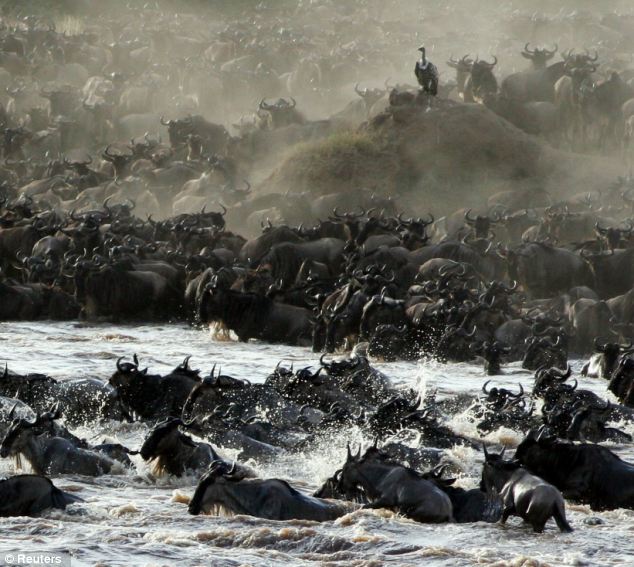


"A fact about the wildebeest migration is that every year, about 1.5 million wildebeest, zebra and several species of antelope uniformly make a circular tour between the Serengeti in Tanzania and Maasai Mara in Kenya, in search of greener pastures.

You can witness the drama unfold as predators lurk in the bushes and prey scamper for safety in what has since been dubbed 'survival for the fittest'...The most notorious among the predators is the lion and the Nile crocodile.

The lion perfectly chooses its arena...shrouded in thick grass cover and gets a strategic hiding spot to attack unsuspecting wildebeest and zebras. During the peak of the migration, vultures circle the air and hyenas laugh in the shadows; an indication of the innumerable wildebeest and zebra that have fallen under the claw of the mighty African lion.

The Nile crocodile however takes the medal as the deadliest predator. It comes in at the climax of the Mara migration - the crossing of the Mara River! This avid killer shapes the events that take place during the crossing of the Mara River."
http://www.kenya-information-guide.com/wildebeest-migration.html

Or elephant male seal versus elephant male seal, bloodying their snouts, seeking dominance and multiple female seals?
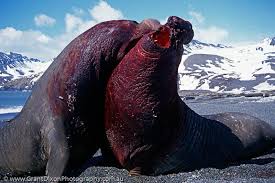


It doesn't appear that cats or mice or crocodiles or elephant seals have a conscience,
a sense of ought,
a rational ability to think in moral categories.

For many thinkers, the central issue isn’t really about any actual “rights” of animals but about reducing the public suffering and cruelty to animals:
“In sixteenth-century Paris, a popular form of entertainment was cat-burning, in which a cat was hoisted in a sling on a stage and slowly lowered into a fire."

"According to historian Norman Davies, ‘the spectators, including kings and queens, shrieked with laughter as the animals, howling with pain, were singed, roasted, and finally carbonized.’ Today, such sadism would be unthinkable in most of the world.”

“This change in sensibilities is just one example of perhaps the most important and most underappreciated trend in the human saga: Violence has been in decline over long stretches of history, and today we are probably living in the most peaceful moment of our species’ time on earth.”
--Steven Pinker (p. 145)

But, of course, the central philosophical question then nags:
Why ought humans to reduce the public suffering and cruelty to animals,
especially,
if far more suffering and cruelty continues in the millions of slaughterhouses around the world that supply billions of slabs of meat for all carnivorous humans?

Are not these billions of meat-eaters, basically, assigning worth to their pet dogs and cats, but denying worth to all the pigs, chickens, cows, and sheep?

Where then are there any “animal rights”?

The evidence of history, nature, and science seems to deny the reality of animal rights.

WHAT DO YOU THINK?

After mulling on this difficult topic for years,
I'm currently at this place: Animals have inherent worth, BUT not Rights.

To be continued--


In the Light of difficult ethical questions,

Daniel Wilcox

Sunday, June 11, 2017

The Whole Human Versus the One-Angled Human


#1 Usually orthodox Christians, Muslims, Jews, and other religionists say they live only by faith (usually narrowly defined)-- belief in the divine, eternal truth of only their own ancient literature by which all other human values must be judged, that all other views are "made-up" or "demonic" or based in "human pride" and "selfishness."


According to them, each human has no “inherent” worth, value, and meaning. Every human and everything else is “worthless” except for whom and what God has given value to in his foreordination, sovereignty and hidden will.

All events in existence including natural disasters, disease, war, famine, crime, and evil etc. are the result of the sovereign will of God.

VERSUS

#2 Usually hard Atheists say they live only by science and reason (usually narrowly defined)--that all other human values are subjective, relative, “made-up,” “constructed,” only “ personal opinion” or “cultural preference” that there are no inherent ethics, no human “rights,” no “justice,” no valid aesthetics, no “better” culture or social framework.

According to them, each human has no “inherent” worth, value, and meaning. Every human and everything else is “worthless” because there is no essential or ultimate reality. Nothing but matter and energy moving eternally.


All events in existence including natural disasters, disease, war, famine, crime, and “so-called evil” are the result of a meaningless, purposeless rigid determinism. All humans are "puppets" and have no choice.

Do you see the irony of this double-mirror, each worldview, perspective negating the other yet almost exactly the mirrored reflection of the other in many significant ways?

FURTHERMORE:

Of course, most religionists don’t only live by “faith.”
They regularly live by “science and reason” when it comes to illness, mechanical failure, running their business, etc.

Most of them don’t live “only by faith.” When they are sick, they consult a doctor, go in for an operation, when their vehicle breaks down, they use tools or take it to a mechanic, when they start a business, they employ an accountant, etc.

And, of course, most atheists don’t live “only by science and reason.”
They regularly support the police and serve on juries which are allegedly based in justice, not subjectivity, that if criminals break into their house or assault their children, it’s not just “subjective,” “relative,” or “made up.”

And they usually send their kids to formal schools be educated in the humanities and aesthetics as well as science.
They don’t assume that the latest scam, National Inquirer news, or scrawl on the side of a building are “equal” to an historical study, meticulously honest fair news or the classics in the library.


Essential or Inherent Humanism seeks to counter both of these ‘one-angled’ extremes which distort reality.


But the explanation of that is for the next post:-)

In the Light,

Daniel Wilcox

Monday, November 28, 2016

Artesian Well of Hope


Most Christian leaders now claim I and many others were never
Christians, never lovers of God,
that our deepest most meaningful experiences and beliefs were false heresies:-(

According to them, we were conceived in sinfulness
and long before our births foreordained to eternal damnation
along with billions of other "worthless" evil humans:-(

It's very weird--and despairing--that even some U.S. Quaker meetings
are promoting such negative religious leaders!

BUT

Back in the 1950's, we grew in a very different sort of religion,
one with a wonderful story,

one where every newly conceived infant was precious and innocent,

one where every human was of inherent worth and value,

one which encouraged us to work for equality, justice, human rights and well-being.

We were convinced that Ultimate Reality
cared about every single human who had ever been born and would ever be born.

My favorite heroes were those compassionate leaders who gave up comfortable lives
and went to harsh places to help the impoverished, the suffering,
and even those who chose and committed unjust, immoral actions.

There was hope for everybody, for every single human being!

When these generous, hopeful leaders spoke at free will Baptist gatherings and conferences, I asked for their autographs and kept them in a special box, like the autographs of sports heroes.

When I discovered the moral truth of the Sermon on the Mount,
that of peacemaking and nonviolence,
one such inspiring leader gave me encouragement to stand up against all those--
almost all the Americans I knew (including our Christian club leader)--who were telling me to go and kill Vietnamese.

I will always be grateful for his witness against the slaughter of war, even if his religion was an illusion.

And I will always be thankful for the witness of Friends in meeting, one of whom
sang of communion, compassion, and inclusion, when I and others were experiencing so much despairing theology.

Here's a short poem in which I tried to distill one very meaningful,
and deeply blessed experience of my hopeful youth.

A transcendent experience, one of ecstatic joy
and the commitment to work for ethical change
and deep idealism--
--

Artesian Well

I can’t carry a basic tune
Anymore than a bat can sing Hebrew
Or envision hieroglyphics,


But once I welled up bursting forth
Beyond all melodious barriers
Of sensuous fountaining,

Songing the voice of all singing.
Hosanna to the Highest and Deepest,
All-embracing universal cosmic Ultimate

Usually, I vocalize low
And hesitantly with insecure effort
But on that humid, many peopled

Saturday evened night in the crowded hall
In the midst of a thousand voiced praise
I not only caroled the Keys but was mused,

Songing the voice of all singing,
Hosanna to the Highest and Deepest
All-embracing universal cosmic Ultimate

We human instruments, fluting beautifully
One glorious open canticled Magnificat
With so much climatic passion;

Me, a human oboe in a great orchestra of tone
Being Bached and Beethovened,
To the alleluiaed heights,

Songing the voice of all singing,
Hosanna to the Highest and Deepest
All-embracing universal cosmic Ultimate.

Lava-hot harmonied, a chorale of joyous, exultant
Joy, the Transcendent's artesian well bursting forth,
Geysering up in ecstatic adulation,

Welling skyward beyond all measuring
Bursting beyond all selves
To God, our lover, all communioned,

Songing the voice of all singing,
Hosanna to the Highest and Deepest
All-embracing universal cosmic Ultimate.

Selah


-Daniel Wilcox

First pub. in
The Clockwise Cat in
different form and in
selah river poetry collection
--

Wednesday, September 14, 2016

Responding to Good without God: Theism Manifesto III


In response to the book, good without God by Greg M. Epstein,
Humanist Chaplain at Harvard University:

Theist Manifesto III

Theism is a progressive philosophy of life that, without supernaturalism, affirms our ability and responsibility to lead ethical lives of personal fulfillment that aspire to the greater good of humanity.

The lifestance of Theism—guided by reason, inspired by compassion, and informed by experience—encourages us to live life well and fully. It evolved through the ages and continues to develop through the efforts of thoughtful people who recognize that values and ideals, however carefully wrought, are subject to change as our knowledge and understandings advance.

This document is part of an ongoing effort to manifest in clear and positive terms the conceptual boundaries of Theism, not what we must believe but a consensus of what we do believe. It is in this sense that we affirm the following:

Knowledge of the world is derived by observation, experimentation, and rational analysis. Theists find that science is the best method for determining this knowledge as well as for solving problems and developing beneficial technologies.

We also recognize the value of new departures in thought, the arts, and inner experience—each subject to analysis by critical intelligence.


Humans are an integral part of nature, the result of unguided evolutionary change. Theists recognize nature as self-existing.

We accept our life as all and enough, distinguishing things as they are from things as we might wish or imagine them to be. We welcome the challenges of the future, and are drawn to and undaunted by the yet to be known.

Ethical values are derived from human need and interest as tested by experience. Theists ground values in human welfare shaped by human circumstances, interests, and concerns and extended to the global ecosystem and beyond.

We are committed to treating each person as having inherent worth and dignity, and to making informed choices in a context of freedom consonant with responsibility.

Life's fulfillment emerges from individual participation in the service of humane ideals. We aim for our fullest possible development and animate our lives with a deep sense of purpose, finding wonder and awe in the joys and beauties of human existence, its challenges and tragedies, and even in the inevitability and finality of death.

Theists rely on the rich heritage of human culture and the lifestance of Theism to provide comfort in times of want and encouragement in times of plenty.

Humans are social by nature and find meaning in relationships. Theists long for and strive toward a world of mutual care and concern, free of cruelty and its consequences, where differences are resolved cooperatively without resorting to violence. The joining of individuality with interdependence enriches our lives, encourages us to enrich the lives of others, and inspires hope of attaining peace, justice, and opportunity for all.


Working to benefit society maximizes individual happiness. Progressive cultures have worked to free humanity from the brutalities of mere survival and to reduce suffering, improve society, and develop global community. We seek to minimize the inequities of circumstance and ability, and we support a just distribution of nature's resources and the fruits of human effort so that as many as possible can enjoy a good life.

Theists are concerned for the well being of all, are committed to diversity, and respect those of differing yet humane views. We work to uphold the equal enjoyment of human rights and civil liberties in an open, secular society and maintain it is a civic duty to participate in the democratic process and a planetary duty to protect nature's integrity, diversity, and beauty in a secure, sustainable manner.

Thus engaged in the flow of life, we aspire to this vision with the informed conviction that humanity has the ability to progress toward its highest ideals. The responsibility for our lives and the kind of world in which we live is ours and ours alone.

from "Postscript: Theism and Its Aspirations,"
Theist Manifesto III
Good with God,
pages 223-225

--

The point is that as a Theist, you'd be in distinguished company along with Thomas Jefferson....Voltaire...

from Introduction,
Good with God, page xii

--

NOW FOR THE TRUTH; "JUST THE FACTS"!

This article is a mild satire, a little early morning irony, because the manifesto is actually a contrary publication, THE VERY WORDS of thinkers who DENY theism!!

All I did was substitute one word, that of "theist" for "humanist."

Again, semantics rule almost everything when it comes to questions of philosophy, cosmology, and reality.

How is it that I could insert "theism" as a substitute for "humanism" throughout this publication, without a hitch?*

Clearly the Manifesto uses terms that are contrary to the central beliefs
of Nontheism, and are the same, or very similar,
to the views of generic Theism*
such as those of Thomas Jefferson
and Voltaire,

and those of the
20th century
mathematician and philosopher
Alfred Lord Whitehead.


Another example of a strong theist is Martin Gardner, the creative skeptic and co-founder of the modern Skpetic movement.


For instance, contrast the Human Manifesto's word choices (look at bolded phrases in the Manifesto versus the word choices of some famous nontheists.

Humanist/Theist Manifesto:

"committed to treating each person as having having inherent worth and dignity"

VERSUS

Humans are "puppets," "wet robots," and "a bag of chemicals,"

When it comes to ethical choice, humans have no more choice than the mass murderer in Texas who was forced to murder by his brain tumor. All humans are like that killer--no choice, it's "tumors all the way down."

And humans have no more choice than "a fly or a bacterium" or "than a bowl of sugar."
Humans are only "mechanical forces of nature..."

"...any fetus is less human than an adult pig."

Etc.

"We are survival machines—robot vehicles blindly programmed to preserve the selfish molecules known as genes."
Richard Dawkins, The Selfish Gene
--

"...long for and strive toward a world of mutual care and concern, free of cruelty and its consequences, where differences are resolved cooperatively without resorting to violence."

"inspires hope of attaining peace, justice, and opportunity for all."

"Progressive cultures have worked to free humanity from the brutalities of mere survival and to reduce suffering, improve society, and develop global community. We seek to minimize the inequities of circumstance and ability, and we support a just distribution of nature's resources and the fruits of human effort so that as many as possible can enjoy a good life."

"Humanists are concerned for the well being of all, are committed to diversity, and respect those of differing yet humane views. We work to uphold the equal enjoyment of human rights and civil liberties in an open, secular society and maintain it is a civic duty to participate in the democratic process and a planetary duty to protect nature's integrity, diversity, and beauty in a secure, sustainable manner."

"greater good"

"inspired by compassion"

"subject to change as our knowledge and understandings advance"

These very important phrases sound much more like the thinking of the Enlightenement theists than many of the negative phrases of modern nontheists.

The strangest part of all of this is that even one of the most militant atheist, Richard Dawkins, states that he doesn't get his ethics from natural evolution!

"[If] there is mercy in nature, it is accidental. Nature is neither kind nor cruel but indifferent."
A Devil's Chaplain

Altruism is a "misfiring" of evolution.
The God Delusion


"A predominant quality to be expected in a gene is ruthless selfishness.
This gene selfishness will usually give rise to selfishness in individual behavior?.
Much as we might wish to believe otherwise, universal love and the welfare
of the species as a whole are concepts that simply do not make evolutionary sense."


"I am not advocating a morality based on evolution. I am saying how things have evolved.
I am not saying how we humans morally ought to behave."

"Let us understand what our own selfish genes are up to, because we may then at least
have the chance to upset their designs, something that no other species has ever aspired to."
The Selfish Gene


--

from an Interview with Richard Dawkins:
Skeptic: Well, if we don't accept religion as a reasonable guide to "what is" or even a reasonable guide to "what ought to be," does evolution give us such a guide? Can we turn to evolution to answer not what is, but what ought to be?

Dawkins: I'd rather not do that. I think Julian Huxley was the last person who attempted to. In my opinion, a society run along "evolutionary" lines would not be a very nice society in which to live.

But further, there's no logical reason why we should try to derive our normative standards from evolution. It's perfectly consistent to say this is the way it is--natural selection is out there and it is a very unpleasant process.

Nature is red in tooth and claw. But I don't want to live in that kind of a world. I want to change the world in which I live in such a way that natural selection no longer applies.

Skeptic: But given the clay from which we are made, doesn't natural selection make it relatively unlikely that some things will work? Doesn't Darwinism undercut the great socialist hope, "Why, because we will it so!"?

Dawkins: Some goals may be unrealistic. But that doesn't mean that we should turn around the other way and say therefore we should strive to make a Darwinian millennium come true.

Skeptic: But then isn't what we ought to do (as David Hume argued long ago) just a matter of preference and choice, custom and habit?

Dawkins: I think that's very likely true. But I don't think that having conceded that point, I as an individual should then be asked to abandon my own ethical system or goals."

I as an individual can adopt idealistic or socialistic or unrealistic or whatever sort of norms of charity and good will towards other people. They may be doomed if you take a strong Darwinian line on human nature, but it's not obvious to me that they are.
--

Skeptic: Can we use Darwinism and natural selection to analyze other events in history? To put it in its crudest form, if Hitler had won WWII would that have proved that his system was better (in a Darwinian sense) than that of the Allies?

Or does the fact that the Soviet Bloc crumbled tell us anything about the relative fitness of market-based economies versus command economies. If might (or at least survival and reproduction) doesn't make right (as well as everything else), what does?

Dawkins: I think it is not helpful to apply Darwinian language too widely. Conquest of nation by nation is too distant for Darwinian explanations to be helpful. Darwinism is the differential survival of self-replicating genes in a gene pool, usually as manifested by individual behavior, morphology, and phenotypes.

Group selection of any kind is not Darwinism as Darwin understood it nor as I understand it. There is a very vague analogy between group selection and conquest of a nation by another nation, but I don't think it's a very helpful analogy. So I would prefer not to invoke Darwinian language for that kind of historical interpretation.
--

Skeptic: In a Darwinian sense, isn't it somewhat meaningless to argue about any supposed displacement of "superior" beings by "inferior" beings, or that evolution "is going backwards." Don't such arguments turn Darwinism on its head?

Dawkins: Because whatever evolves is, by definition, superior? There's nothing nonsensical about saying that what would evolve if Darwinian selection has its head is something that you don't want to happen. And I could easily imagine trying to go against Darwinism. I don't see why that's inconsistent.

I can easily imagine saying that in a Darwinian world, the fittest, by definition, are the ones that survive and the attributes that you need to survive in Darwinian sense are the attributes that I don't want to see in the world. I can easily see myself fighting against the success of Darwinism prevailing in the world.

...Even if it did, and this is a stronger point, I would oppose any suggestion from any group such as the National Front, that whatever occurs in natural selection is therefore morally good or desirable. We come back to this point over and over again. I'm definitely not one who thinks that "is" is the same as "ought"

...I'm happy for people to make speculations along those lines as long as they don't again jump that is-ought divide and start saying, "therefore racism is a good thing." I don't think racism is a good...it's a very bad thing. That is my moral position. I don't see any justification in evolution either for or against racism. The study of evolution is not in the business of providing justifications for anything.

Skeptic: You also took a bit of flak for likening religion (I think specifically Catholicism) to a virus? Is that still your position?

Dawkins: Yes...I do think that the Roman Catholic religion is a disease of the mind which has a particular epidemiology similar to that of a virus.

Skeptic: But couldn't the Pope (or Evangelical Protestants for that matter), reply, "Look, we just have a terrific meme. It's winning what you would describe as a Darwinian battle and you're angry because you just don't like it."

Dawkins: Religion is a terrific meme. That's right. But that doesn't make it true and I care about what's true. Smallpox virus is a terrific virus. It does its job magnificently well. That doesn't mean that it's a good thing. It doesn't mean that I don't want to see it stamped out.

Skeptic: So once again the discussion goes back to how do you determine whether something is good or not, other than by just your personal choice?

Dawkins: I don't even try. You keep wanting to base morality on Darwinism. I don't.
--
from Interview
by Frank Miele, Skeptic Magazine
http://www.skeptic.com/eskeptic/10-10-27/
--

*(Though all of this is NOT, of course, true of doctrinal and creedal religions such as Islam, Christianity, and Hinduism.)


In the Light of Meaning and Purpose,

Daniel Wilcox